
Latest News
Protest against load shedding in Karachi’s Mauripur ends after 24 hours


- Protest in Mauripur continued for more than 24 hours.
- Protesters clashed with LEA personnel.
- Pakistan witnesses shortfall of 5,500MW electricity.
KARACHI: The protest against loadshedding in Karachi’s Mauripur area — which continued for almost a day — ended on Tuesday evening after area residents decided to disperse and return home.
According to Deputy Commissioner South Abdul Sattar, the protesters decided to call the demonstrations off after successfully negotiating with authorities.
He added that previously, some people had refused to comply and continued protesting despite being assured that their grievances would be addressed. As a result, the protests continued for more than 24 hours.
Sattar also said that traffic in the area has been restored, which had been blocked because of the demonstration. Traffic from the ICI bridge to the Lyari Expressway, which had been suspended, has also been restored.
Protests turn violent
Earlier in the day, the protest had taken a violent turn after participants clashed with law enforcement agencies (LEAs), leaving a policeman and several protesters injured.
The protesters said that the area was witnessing constant loadshedding despite them paying their utility dues.
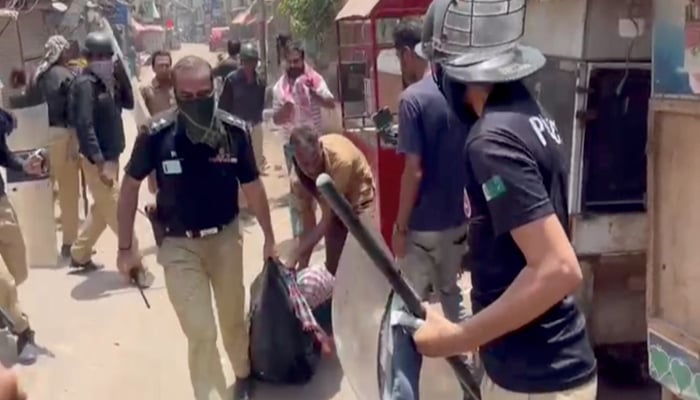
The police and Rangers personnel tried to get the situation under control, however, the protesters did not go on the back foot and pelted stones at them.
Sources in the National Transmission & Despatch Company (NTDC) told Geo News that the country’s supply is 22,500 megawatts, while the demand is 28,000 megawatts, leaving a shortfall of 5,500 megawatts — this has led to several hours of power outages.
In Karachi’s Gadap Town, the loadshedding time has gone up to 18 hours in a day, while Shah Faisal Colony, Malir, Surjani Town, Gulistan-e-Jauhar, areas around Jahangir Road, Sultanabad and Kala Pul, among some other areas, are seeing power outages of 14 hours or more.
Police said they arrested four protesters and used water cannons to disperse them. A day earlier, people took to the streets in Teen Hatti, Saddar Preedy Street, Jubilee Market, Shah Faisal Colony, Surjani Town, University Road, MT Khan Road, Nishtar Road, and 14 other areas of the metropolis.
No death reported: police
In a statement, City SSP Asif Bughio rejected reports that an elderly woman had died after getting injured during the protests.
Denying the reports of her death during the protest, he said that the woman was of 70 years and the police were in contact with the deceased’s family for conducting her post-mortem.
“There is a power outage of more than 12 hours in the area. The residents are demanding that a first information report (FIR) be registered against her death,” the SSP said.
More loadshedding
Sindh Energy Minister Imtiaz Shaikh, meanwhile, contacted KE chief executive Moonis Alvi. He noted that loadshedding has made the lives of people miserable and demanded the power utility resolve the crisis on an emergency basis.
“Due to persistent loadshedding, the security situation is deteriorating,” he told the KE official, calling on the federal government to clear the dues of the power utility as it “does not have the funds to produce power through furnace oil”.
Apart from Karachi, the loadshedding situation is also getting worse in Punjab as approximately six to eight hours of power outages are taking place across the province, while in the rural areas, electricity is being provided for only a few hours.
A day earlier, while addressing MNAs from the PML-N and allied parties, Prime Minister Shehbaz Sharif warned the country might face increased loadshedding in the coming month of July.
Pakistan is facing an escalation of its power crisis after it failed to agree on a deal for natural gas supply next month. Tenders for July were scrapped due to high price, and low participation as the nation is already taking action to tackle widespread blackouts.








YouTube’s famous couple Sham Idrees and Froggy aka Sehar are taking sometime away from each other in their relationship.
Sham, taking it to his Instagram, left his fans in a shock after announcing his separation with Froggy. He wrote: “I would like to announce that me and froggy are taking sometime away from each other in our relationship. Please don’t involve me in issues concerning froggy, rabil or any of the other family members. I appreciate some privacy during this difficult time.”

Sham is a Canadian based YouTuber, who has a following of 1.4 million people on Instagram, is widely-known for his entertaining content. His videos often feature his wife Sehar along with him.
The couple tied the knot a few years ago and is parents to baby Sierra who is two-years old. The duo welcomed another daughter on September 28, 2022. They named her Shanaya Idrees.
After the birth of his first daughter, Sham Idrees also introduced his fans to his daughter Dua from his previous marriage.

- Minister says power generation units are temporarily shut in winter at night.
- Says frequency variation in national grid triggered outage.
- Says ministry trying to restore power in next 12 hours.
LAHORE/KARACHI/QUETTA/ISLAMABAD: A countrywide power breakdown, triggered by a “frequency variation” in the national grid early Monday morning, has left large parts of the country including Karachi, Lahore, Islamabad, Peshawar and Quetta without electricity.
Power Minister Khurrum Dastagir, while talking to Geo News, said that the power generation units are temporarily shut down in winter at night as an economic measure to save fuel costs.
“When the systems were turned on at 7:30am this morning one by one, frequency variation was reported in the southern part of the country between Jamshoro and Dadu. There was a fluctuation in voltage and power generating units were shut down one by one due to cascading impact. This is not a major crisis,” said the federal minister as the country plunged into darkness for the second time in four months.
The minister said that his ministry has started restoring some grid stations in Tarbela and Warsak.
“Peshawar Electric Supply Company (PESCO) and some grids of Islamabad Electric Supply Company (IESCO) have already been restored,” claimed the minister.
Talking about the breakdown in Karachi, the minister said that the matter in the port city is complicated as it has a complete electric supply system.
“We provide K-Electric about 1,000-1,100 megawatts routinely, however, it will be restored within a few hours. It is not certain how long will it take to sort this issue. However, my target is to restore electricity in the country in the next 12 hours,” said the minister.
Before the energy ministry’s announcement, different power distribution companies had confirmed the breakdown.
According to Quetta Electric Supply Company (QESCO), the two transmission lines have tripped leaving 22 districts of Balochistan, including Quetta without power.
Karachi power update
Meanwhile, K-Electric spokesperson Imran Rana said that at approximately 7:34am today, the national grid experienced a loss of frequency, affecting the power supply to multiple cities across Pakistan
“This has also cascaded to KE’s network affecting power supply to Karachi,” Rana said, adding the KE’s network is safe and protected.
“Our teams are actively monitoring the situation and enabling restoration efforts.”
An IESCO spokesperson said that its 117 grid stations were without electricity.
Meanwhile, PESCO also confirmed the outage in areas where it supplies electricity.
This is the second time within four months that a country was hit by a major power breakdown.
NEPRA takes notice
The National Electric Power Regulatory Authority (NEPRA), in a statement, said that it has taken “serious notice” of the power outage and directed the National Transmission & Despatch Company (NTDC) to submit a “detailed report”.
The statement also said that the regulator has previously imposed fines on similar outages in the 2021 and 2022. It also shared that NEPRA has consistently issued directives and recommendations on tackling such events in future.
Previous breakdown
In October of last year, Karachi, Hyderabad, Sukkur, Quetta, Multan, and Faisalabad were hit by a power outage.
At that time, the power minister said that nearly 8,000 megawatts of power went offline.
Back then, Dastagir had said that the simultaneous faults in two power lines, which had triggered the breakdown, at the same time was concerning for the government. He had also announced that an in-depth inquiry was ordered and promised action.
A timeline of power breakdowns in Pakistan
The country’s generation and distribution network has suffered eight major power breakdowns during the last nine years.
In 2014 and 2017, nationwide blackouts were caused by a fault in Tarbela Power Station while fog, frequency variation and the Guddu Power Plant fault were blamed for breakdowns in 2015, 2018, 2019, 2021, 2022 and 2023.
Every time the party in power announced to conduct a comprehensive probe and vowed to rectify the issues but nothing has happened despite multiple inquiries.


Supreme Court annuls trials of civilians in military courts

Sea conditions ‘very high’ as Cyclone Tej moves towards northwestward

IMF condition: ECC set to green light gas tariff hike today

Barwaan Khiladi: Kinza Hashmi discusses her role as Alia

Snap launches tools for parents to monitor teens’ contacts

WATCH: Pakistani traveller deported from Dubai for damaging plane mid-air

Learn First | How to Create Amazon Seller Account in Pakistan – Step by Step

Sajjad Jani Funny Mushaira | Funny Poetry On Cars🚗 | Funny Videos | Sajjad Jani Official Team
