Connect with us

Business

Monetary policy: SBP hikes interest rate to 16% to curtail inflation

Published

on

  • “Decision aims to ensure elevated inflation does not become entrenched,” SBP says.
  • SBP increased rate cumulatively by 900 basis points since Sept 2021 to Nov 2022.
  • MPC says it will continue to carefully monitor developments affecting prospects for inflation, growth.

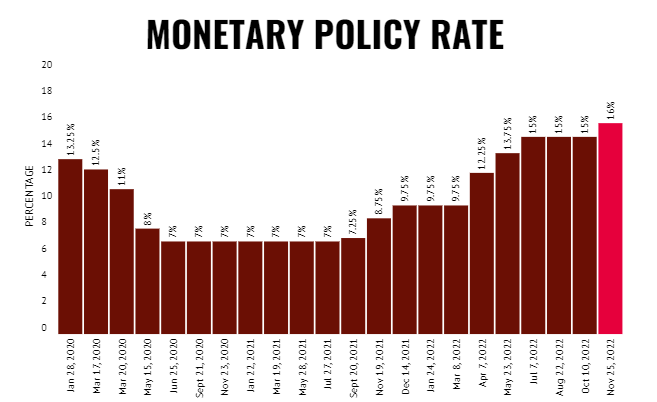
KARACHI: The Monetary Policy Committee (MPC) of the State Bank of Pakistan (SBP) Friday raised the key policy rate by 100 basis points to 16% — the highest since 1999.

The central bank, in a statement, issued after the meeting said that the decision reflects the MPC’s view that inflationary pressures have proven to be stronger and more persistent than expected.

“This decision is aimed at ensuring that elevated inflation does not become entrenched and that risks to financial stability are contained, thus paving the way for higher growth on a more sustainable basis,” the MPC said.

The SBP noted that amid the ongoing economic slowdown, inflation is increasingly being driven by persistent global and domestic supply shocks that are raising costs.

“In turn, these shocks are spilling over into broader prices and wages, which could de-anchor inflation expectations and undermine medium-term growth,” the statement read, adding that consequently the rise in cost-push inflation cannot be overlooked and necessitates a monetary policy response.

The MPC further noted that the short-term costs of bringing inflation down are lower than the long-term costs of allowing it to become entrenched. Meanwhile, curbing food inflation through administrative measures to resolve supply-chain bottlenecks and any necessary imports remains a high priority.

The central bank increased the rate by a cumulative 900 basis points in 15 months (September 2021 to November 2022) to 16%.
The MPC, Since the last meeting, noted three key domestic developments, including:

  • Headline inflation increased sharply in October, food prices also accelerated significantly, and core inflation has risen further
  • A sharp decline in imports led to a significant moderation in the current account deficit in both September and October
  • After incorporating Post-Disaster Needs Assessment of floods, the FY23 projections for growth of around 2% and current account deficit of around 3% of GDP are re-affirmed.

However, the committee mentioned that higher food prices and core inflation are now expected to push average FY23 inflation up to 21-23%. 

Key projections for FY23

  • Growth rate in FY23 to clock in at 2%
  • Current account deficit to remain around 3% of GDP shared
  • Average FY23 inflation to be calculated around to 21-23%
  • Forex reserves expected to improve gradually
  • Inflation expected to fall toward upper range of the 5-7% 

External sector

The MPC mentioned that on the financing side, inflows are being negatively affected by domestic uncertainty and tightening global financial conditions as major central banks continue to raise policy rates. 

The financial account recorded a net inflow of $1.9 billion during the first four months of FY23, compared to $5.7 billion during the same period last year.

“Looking ahead, higher imports of cotton and lower exports of rice and textiles in the aftermath of the floods should be broadly offset by a continued moderation in overall imports due to the economic slowdown and softer global commodity prices,” it said.

The committee predicted the current account deficit is expected to remain moderate in FY23, with foreign exchange reserves gradually improving as anticipated external inflows from bilateral and multilateral sources materialise.

The central bank said that if the recent decline in global oil prices intensifies or the pace of rate hikes by major central banks slows, pressures on the external account could diminish further. 


Monetary and inflation outlook

As part of its forward guidance, the MPC said that it will continue to carefully monitor developments affecting medium-term prospects for inflation, financial stability, and growth.

The central bank noted that headline inflation rose by almost 3½ percentage points in October to 26.6% year-on-year, driven by normalization of fuel cost adjustments in electricity tariffs and rising prices of food items.

Energy and food prices rose by 35.2 and 35.7% year-on-year, respectively. Meanwhile, core inflation increased further to 18.2 and 14.9% year-on-year in rural and urban areas respectively, as rising food and energy inflation seeped into broader prices, wages and inflation expectations.

“As a result of these developments, inflation projections for FY23 have been revised upwards. While inflation is likely to be more persistent than previously anticipated, it is still expected to fall toward the upper range of the 5-7% medium-term target by the end of FY24, supported by prudent macroeconomic policies, orderly Rupee movement, normalising global commodity prices and beneficial base effects,” the statement read.

Moreover, it was noted that in line with the slowdown in economic activity, private sector credit continued to moderate, increasing only by Rs86.2 billion during the first quarter of the fiscal year 2022-23 compared to Rs226.4 billion during the same period last year.

The central bank attributed this deceleration to a significant decline in working capital loans to wholesale and retail trade services as well as to the textile sector in the wake of lower domestic cotton output, and a slowdown in consumer finance. 

Business

Supreme Court annuls trials of civilians in military courts

Published

on

By

In a unanimous verdict, a five-member bench of the Supreme Court on Monday declared civilians’ trials in military courts null and void as it admitted the petitions challenging the trial of civilians involved in the May 9 riots triggered by the arrest of Pakistan Tehreek-e-Insaf (PTI) chief Imran Khan in a corruption case.

The five-member apex court bench — headed by Justice Ijaz Ul Ahsan, and comprising Justice Munib Akhtar, Justice Yahya Afridi, Justice Sayyed Mazahar Ali Akbar Naqvi and Justice Ayesha Malik — heard the petitions filed by the PTI chief and others on Monday.

The larger bench in its short verdict ordered that 102 accused arrested under the Army Act be tried in the criminal court and ruled that the trial of any civilian if held in military court has been declared null and void.  

The apex court had reserved the verdict earlier today after Attorney General of Pakistan (AGP) Mansoor Usman Awan completed his arguments centred around the domain and scope of the military courts to try the civilians under the Army Act. 

At the outset of the hearing today, petitioner lawyer Salman Akram Raja told the bench that trials of civilians already commenced before the top court’s verdict in the matter.

Responding to this, Justice Ahsan said the method of conducting proceedings of the case would be settled after Attorney General of Pakistan (AGP) Mansoor Usman Awan completed his arguments.

Presenting his arguments, the AGP said he would explain to the court why a constitutional amendment was necessary to form military courts in 2015 to try the terrorists.

Responding to Justice Ahsan’s query, AGP Awan said the accused who were tried in military courts were local as well as foreign nationals.

He said the accused would be tried under Section 2 (1) (D) of the Official Secrets Act and a trial under the Army Act would fulfill all the requirements of a criminal case.

“The trial of the May 9 accused will be held in line with the procedure of a criminal court,” the AGP said.

The AGP said the 21st Amendment was passed because the terrorists did not fall in the ambit of the Army Act.

“Amendment was necessary for the trial of terrorists [then] why amendment not required for the civilians? At the time of the 21st constitutional amendment, did the accused attack the army or installations?” inquired Justice Ahsan.

AGP Awan replied that the 21st Amendment included a provision to try accused involved in attacking restricted areas.

“How do civilians come under the ambit of the Army Act?” Justice Ahsan asked the AGP.

Justice Malik asked AGP Awan to explain what does Article 8 of the Constitution say. “According to Article 8, legislation against fundamental rights cannot be sustained,” the AGP responded.

Justice Malik observed that the Army Act was enacted to establish discipline in the forces. “How can the law of discipline in the armed forces be applied to civilians?” she inquired.

The AGP responded by saying that discipline of the forces is an internal matter while obstructing armed forces from discharging duties is a separate issue.

He said any person facing the charges under the Army Act can be tried in military courts.

“The laws you [AGP] are referring to are related to army discipline,” Justice Ahsan said.

Justice Malik inquired whether the provision of fundamental rights be left to the will of Parliament.

“The Constitution ensures the provision of fundamental rights at all costs,” she added.

If the court opened this door then even a traffic signal violator will be deprived of his fundamental rights, Justice Malik said.

The AGP told the bench that court-martial is not an established court under Article 175 of the Constitution.

At which, Justice Ahsan said court martials are not under Article 175 but are courts established under the Constitution and Law.

After hearing the arguments, the bench reserved the verdict on the petitions.

A day earlier, the federal government informed the apex court that the military trials of civilians had already commenced.

After concluding the hearing, Justice Ahsan hinted at issuing a short order on the petitions. 

The government told the court about the development related to trials in the military court in a miscellaneous application following orders of the top court on August 3, highlighting that at least 102 people were taken into custody due to their involvement in the attacks on military installations and establishments. 

Suspects express confidence in mly courts

The same day, expressing their “faith and confidence” in military authorities, nine of the May 9 suspects — who are currently in army’s custody — moved the Supreme Court, seeking an order for their trial in the military court be proceeded and concluded expeditiously to “meet the ends of justice”.

Nine out of more than 100 suspects, who were in the army’s custody, filed their petitions in the apex court via an advocate-on-record.

The May 9 riots were triggered almost across the country after former prime minister Imran Khan’s — who was removed from office via a vote of no confidence in April last year — arrest in the £190 million settlement case. Hundreds of PTI workers and senior leaders were put behind bars for their involvement in violence and attacks on military installations.

Last hearing

In response to the move by the then-government and military to try the May 9 protestors in military courts, PTI Chairman Imran Khan, former chief justice Jawwad S Khawaja, lawyer Aitzaz Ahsan, and five civil society members, including Pakistan Institute of Labour Education and Research (Piler) Executive Director Karamat Ali, requested the apex court to declare the military trials “unconstitutional”.

The initial hearings were marred by objections on the bench formation and recusals by the judges. Eventually, the six-member bench heard the petitions.

However, in the last hearing on August 3, the then-chief justice Umar Ata Bandial said the apex court would stop the country’s army from resorting to any unconstitutional moves while hearing the pleas challenging the trial of civilians in military courts.

A six-member bench, led by the CJP and comprising Justice Ijaz Ul Ahsan, Justice Munib Akhtar, Justice Yahya Afridi, Justice Sayyed Mazahar Ali Akbar Naqvi, and Justice Ayesha Malik, heard the case.

In the last hearing, the case was adjourned indefinitely after the Attorney General for Pakistan (AGP) Mansoor Usman Awan assured the then CJP that the military trials would not proceed without informing the apex court.

Continue Reading

Business

IMF condition: ECC set to green light gas tariff hike today

Published

on

By

  • Tariff may go up by 173% for non-protected domestic consumers. 
  • Petroleum Division to push for implementation of hike from Oct 1. 
  • Circular debt to increase by Rs15bn if hike implemented from today.

ISLAMABAD: The Economic Coordination Committee (ECC) will meet today (Monday) to green-light the plan to hike the gas tariff, a key part of the International Monetary Fund (IMF) conditions, including a zero hike in the gas circular debt for the ongoing financial year 2023-24, reported The News.

The government is likely to increase the local gas tariff up to 173% for non-protected domestic consumers, 136.4% for commercial, 86.4% for export and 117% for the non-export industry.

Since there is no budgeted subsidy for even domestic, commercial, and industrial sectors, the high-end consumers will provide cross-subsidies to low-end consumers.

The government’s failure to hike the gas prices from July 1 has forced it to incur a loss of Rs50 billion during the July-September in the gas sector. But the losses will be bridged when the government moves ahead with the increase in the gas tariff which would give enough monetary space to recover with the loss.

As per the publication, the IMF has been taken onboard on this point. It has been informed that the gas prices would be increased in such a manner that it would not increase the circular debt during this financial year, which right now stands at Rs2.9 trillion.

However, now the Petroleum Division will try to ensure that the gas tariff hike is implemented from October 1. If the government decides to implement the hike from today onwards then the circular debt would increase by Rs15 billion.

But there would be no increase in the gas tariff from January 1, 2024, a further gas tariff increase would be implemented as under the law, the review of gas prices is carried out bi-annually.

The cement sector will have to purchase the gas 193.3% higher than the current cost, making it the biggest bearer of the brunt, from 1,500 per MMBtu to Rs4,400 per MMBtu.

The CNG sector, will face the second-highest increase in gas tariff by 143.8% from Rs1,805 per MMBtu to Rs4,400.

If the hike is approved, then it means that cement prices will skyrocket and CNG will be much more expensive than petrol.

The government, however, does not plan on increasing the tariff for tandoors which would ensure that roti prices remain stable.

The summary prepared by the petroleum ministry that is to be pitched today in the ECC meeting shows it has not spared the four protected domestic consumer categories as ostensibly it has not proposed to increase their gas tariffs but hiked their monthly fixed charges from Rs10 to Rs400 per month.

More importantly, the Petroleum Division has also proposed to escalate the per month fixed charges for the first 4 non-protected domestic consumers by 117.4% to Rs1,000 from Rs460 per month from their gas tariffs increase by 50-150%. Also, to be increased are per month fixed charges for the remaining 4 non-protected domestic consumers, by 334.78%, to Rs2,000 from Rs460 per month part, increasing their gas tariff by 100%-173%.

The summary states that SNGPL will now offer a blend of natural gas and RLNG in a 20:80 ratio to non-export industry out of the estimated volumes for industrial consumers, both process and captive, as per petitions filed by SNGPL to OGRA for revenue determination.

The blend offered by the Sui companies shall be reviewed every quarter based on the availability of natural gas and RLNG. And SSGC shall offer a blend of NG and RLNG of 90:10 out of the estimated volumes for industrial consumers, both process and captive, as per petitions filed by SSGC to OGRA for revenue determination.

Coming to the export industry, the summary says that currently, there is a wide price disparity between the industry operating on SSGCL and SNGPL networks. Industry in the north (operating on the SNGPL network) consumes a 50:50 blend of indigenous and RLNG for 9 months (Mar to Nov) and 100% RLNG for 3 months (Dec-Feb), averaging to the current tariff of $9.6/MMBtu (Rs2,790) over the year.

On the other hand, process connections of the industry in the south (operating on SSGCL) are being charged at Rs1,100/MMBtu. SSGC has recently started a supply of blend in the proportion of 75:25 for captive use of gas, which approximates $5.9/MMBtu (Rs1,710).

Continue Reading

Business

Govt to only finance important projects for provinces: SIFC

Published

on

By

  • PSDP listed projects to be presented before CCER for review.
  • Finance minister to chair CCER meeting upon return from Morocco.
  • “Exercise to abandon provincial projects underway,” top official says.

ISLAMABAD: The Special Investment Facilitation Council (SIFC) has decided to only finance extremely important development projects in the provinces with 50% of funds allocated by the federal government and provinces each, The News reported.

The Planning Ministry has, meanwhile, identified all the Public Sector Development Programmes (PSDP) listed projects to be presented before the Cabinet Committee on Economic Revival (CCER) with its aims to scrap all such schemes and save Rs314 billion under the austerity drive.

Finance Minister Dr Shamshad Akhtar, following her return from Morocco where she is attending the annual meetings of the World Bank and International Monetary Fund (IMF), will be chairing the CCER meeting.

“The exercise to abandon the provincial nature projects from PSDP list is underway,” a top government official said on Thursday.

It was decided in the last SIFC’s Apex Committee meeting that development projects of provincial nature would only be executed in the future through the cost-sharing of 50%:50% of funds borne by both the Centre and provinces. “If the provincial government does not bear 50% cost on an equal basis, the Centre will not provide its share of funding,” another top official source confirmed while talking to The News.

One senior official said the decision had already been taken up by the Executive Committee of the National Economic Council (ECNEC). The SIFC’s Executive Committee is scheduled to meet early next week to undertake all spadework for tabling it before the apex committee under the chairmanship of Caretaker Prime Minister Anwar-ul-Haq Kakar in the coming weeks.

So far, the SIFC has remained unable to finalise much-awaited multi-billion dollar transactions for attracting investments but it is making all-out efforts to lure foreign investors in areas of mining, IT, agriculture, and others.

One of the future SIFC agendas for considering mechanisms for corporate farming lies on the table. Although some initial work was done during the tenure of late Gen (retd) Musharraf, still there is a need to undertake its basic framework in a detailed manner before striking pacts with international investors. However, it is critical to hire technical experts for drafting international agreements and steering the negotiations against the backdrop of several past agreements ending up in disputes due to a lack of technical capacity.

Meanwhile, different ministries/divisions have been directed to undertake steps under the austerity plans to ensure savings. The Ministry of Finance instructed all its wings and attached departments to review all the foreign visits and banned all those deemed necessary next week.

Continue Reading

Trending