Pakistan
Heatwaves, rains, floods: Climate change is here and Pakistan needs to act now
Published
4 years agoon
By
Climate-induced migration is a harsh reality that Pakistan faces. Not everyone will be able to go back to their original place of residence after the waters recede, in fact, that place may not exist anymore.
Social media is awash with horrifying images of the havoc monsoon rains that have wreaked on a wide swathe of Pakistan.
People living in low-lying areas, in the path of hill torrents, or on poorly made embankments are awash in the misery of floods brought in the wake of the monsoon spell.
However, if we remove the date from the posts, and newspaper and television reports, the realisation would dawn that we have seen such images many times in the past.
Repeatedly, there have been glacial lake outburst floods in Khyber Pakhtunkhwa and Gilgit-Baltistan, which rarely make it into the headlines.
Hill torrents raging down their beds, streams and rivers bursting their banks and sweeping away whatever comes in their way in Balochistan, leading to massive damage and loss of lives and livestock are a familiar feature whenever there are torrential rains. These have been alternating with the other extreme of drought, to which this region is also prone.
Sindh suffers from too little, and then too much water. This year, like a previous couple of years, the monsoon has been punishing and relentless.
Its towns and cities are inundated and there seems to be no end to the misery of the people because the water levels are not subsiding. The provincial capital, Karachi, has taken a battering due to unprecedented rains that have broken all previous records.
While parts of Punjab suffered from what is still being called a ‘pre-monsoon’ spell, with heavy rain and hail storms in March which flattened standing crops. And all of the above came on the heels of a severe heat spell that impacted all parts of the country, even the northern glacial valleys, which experienced temperatures in excess of 30 degrees centigrade.
What is causing the extreme weather events in Pakistan?
Well, this is what climate scientists and meteorological experts have been warning about for years now.
The unpredictability, frequency, and ferocity of weather events are one of the manifestations of climate change. Rising sea surface temperatures mean more moisture uptake by the weather systems, which then drop them over the land in unprecedented volumes. Our systems are just not geared to cope with even half that volume.
Hence, we see the flooded streets and overflowing drains in the cities.
Nature manifests its wrath at the obstructions put in its way by humans by reclaiming the river and stream beds, and slopes stripped barren off the soil binding tree cover by bringing down boulders and debris in the hill tracts and alongside the river banks.
Former director general of Pakistan’s Meteorological Department, Dr Qamaruzzaman Chaudhury, has said that the erratic nature of the precipitation and extreme events are a clear indication of the impacts of climate change.
This is why Pakistan must focus on ‘Climate Proofing’ its infrastructure and systems against the shocks of nature. That is the only way to cope since there is little way of mitigation that we can do.
Could the damage have been minimized?
Yes. As Arif Goheer, a scientist at the Islamabad-based Global Change Impacts Studies Center points out that the warning had been sounded way back in April by the South Asian Climate Outlook Forum.
The outlook was developed by climate experts from eight South Asian countries, as well as international experts doing climate modelling.
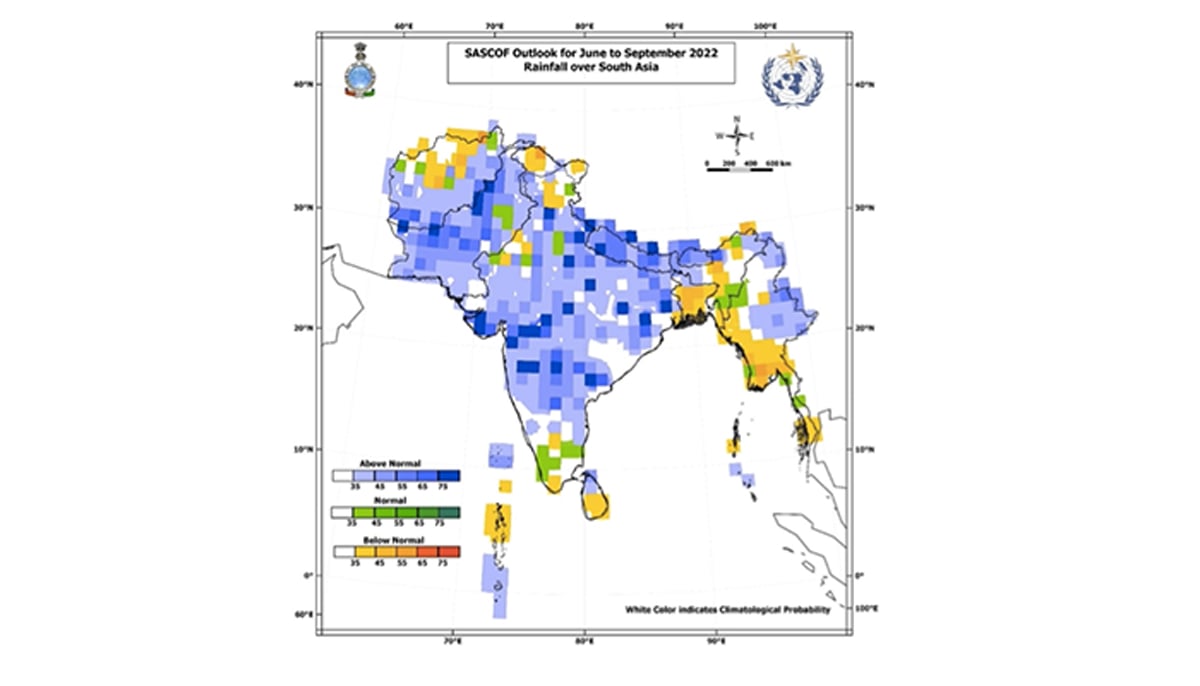
The map clearly shows the extent and the intensity predicted. The period being cited is June to September, which means more is yet to come.
Usually, in Pakistan, the monsoon commences in August. This year June and July have been debilitating. On the basis of this information, Pakistan’s own Meteorological Department put out the Monsoon Outlook on June 7.
But were the municipal services ready? No.
Were the disaster ‘management’ bodies ready? No.
Were the communication departments of the provinces, responsible for roads and bridges, ready? No.
We are seeing the same reactive response that we have seen in the wake of natural disasters before, therefore rescue and relief. While rehabilitation is still a long way off.
Why were the vulnerable areas not mapped? Why were rescue parties not posted before bridges collapsed and roads were washed away?
Thankfully Pakistan has community organizations and philanthropic organisations, which have morphed into disaster management organisations that always swing into action when disaster strikes.
These organisations rely on the large-heartedness of fellow Pakistanis. But instead of them acting as supplementing the efforts of the government agencies, they assume the role of the primary relief providers.
Climate change is not something in the future. It is here and now.
Knee jerk actions like rescue and relief, which are the need of the hour, will not suffice.
Climate-induced migration is a harsh reality that Pakistan faces. Not everyone will be able to go back to their original place of residence after the waters recede, in fact, that place may not exist anymore. Or may have been stripped of all the resources that allowed them to make a living there.
An infrastructure audit needs to be done.
We are a data deficient country. But if there is one thing that climate change needs to change is the ad hoc approach to dealing with disasters like the present rains.
We need to map out vulnerable ecosystems, people and biodiversity in those regions and see how to shore up the coping mechanisms.
The science-academia-government departments’ nexus needs to be built and strengthened if we are to get out of the reactive mode.
You may like
In a unanimous verdict, a five-member bench of the Supreme Court on Monday declared civilians’ trials in military courts null and void as it admitted the petitions challenging the trial of civilians involved in the May 9 riots triggered by the arrest of Pakistan Tehreek-e-Insaf (PTI) chief Imran Khan in a corruption case.
The five-member apex court bench — headed by Justice Ijaz Ul Ahsan, and comprising Justice Munib Akhtar, Justice Yahya Afridi, Justice Sayyed Mazahar Ali Akbar Naqvi and Justice Ayesha Malik — heard the petitions filed by the PTI chief and others on Monday.
The larger bench in its short verdict ordered that 102 accused arrested under the Army Act be tried in the criminal court and ruled that the trial of any civilian if held in military court has been declared null and void.
The apex court had reserved the verdict earlier today after Attorney General of Pakistan (AGP) Mansoor Usman Awan completed his arguments centred around the domain and scope of the military courts to try the civilians under the Army Act.
At the outset of the hearing today, petitioner lawyer Salman Akram Raja told the bench that trials of civilians already commenced before the top court’s verdict in the matter.
Responding to this, Justice Ahsan said the method of conducting proceedings of the case would be settled after Attorney General of Pakistan (AGP) Mansoor Usman Awan completed his arguments.
Presenting his arguments, the AGP said he would explain to the court why a constitutional amendment was necessary to form military courts in 2015 to try the terrorists.
Responding to Justice Ahsan’s query, AGP Awan said the accused who were tried in military courts were local as well as foreign nationals.
He said the accused would be tried under Section 2 (1) (D) of the Official Secrets Act and a trial under the Army Act would fulfill all the requirements of a criminal case.
“The trial of the May 9 accused will be held in line with the procedure of a criminal court,” the AGP said.
The AGP said the 21st Amendment was passed because the terrorists did not fall in the ambit of the Army Act.
“Amendment was necessary for the trial of terrorists [then] why amendment not required for the civilians? At the time of the 21st constitutional amendment, did the accused attack the army or installations?” inquired Justice Ahsan.
AGP Awan replied that the 21st Amendment included a provision to try accused involved in attacking restricted areas.
“How do civilians come under the ambit of the Army Act?” Justice Ahsan asked the AGP.
Justice Malik asked AGP Awan to explain what does Article 8 of the Constitution say. “According to Article 8, legislation against fundamental rights cannot be sustained,” the AGP responded.
Justice Malik observed that the Army Act was enacted to establish discipline in the forces. “How can the law of discipline in the armed forces be applied to civilians?” she inquired.
The AGP responded by saying that discipline of the forces is an internal matter while obstructing armed forces from discharging duties is a separate issue.
He said any person facing the charges under the Army Act can be tried in military courts.
“The laws you [AGP] are referring to are related to army discipline,” Justice Ahsan said.
Justice Malik inquired whether the provision of fundamental rights be left to the will of Parliament.
“The Constitution ensures the provision of fundamental rights at all costs,” she added.
If the court opened this door then even a traffic signal violator will be deprived of his fundamental rights, Justice Malik said.
The AGP told the bench that court-martial is not an established court under Article 175 of the Constitution.
At which, Justice Ahsan said court martials are not under Article 175 but are courts established under the Constitution and Law.
After hearing the arguments, the bench reserved the verdict on the petitions.
A day earlier, the federal government informed the apex court that the military trials of civilians had already commenced.
After concluding the hearing, Justice Ahsan hinted at issuing a short order on the petitions.
The government told the court about the development related to trials in the military court in a miscellaneous application following orders of the top court on August 3, highlighting that at least 102 people were taken into custody due to their involvement in the attacks on military installations and establishments.
Suspects express confidence in mly courts
The same day, expressing their “faith and confidence” in military authorities, nine of the May 9 suspects — who are currently in army’s custody — moved the Supreme Court, seeking an order for their trial in the military court be proceeded and concluded expeditiously to “meet the ends of justice”.
Nine out of more than 100 suspects, who were in the army’s custody, filed their petitions in the apex court via an advocate-on-record.
The May 9 riots were triggered almost across the country after former prime minister Imran Khan’s — who was removed from office via a vote of no confidence in April last year — arrest in the £190 million settlement case. Hundreds of PTI workers and senior leaders were put behind bars for their involvement in violence and attacks on military installations.
Last hearing
In response to the move by the then-government and military to try the May 9 protestors in military courts, PTI Chairman Imran Khan, former chief justice Jawwad S Khawaja, lawyer Aitzaz Ahsan, and five civil society members, including Pakistan Institute of Labour Education and Research (Piler) Executive Director Karamat Ali, requested the apex court to declare the military trials “unconstitutional”.
The initial hearings were marred by objections on the bench formation and recusals by the judges. Eventually, the six-member bench heard the petitions.
However, in the last hearing on August 3, the then-chief justice Umar Ata Bandial said the apex court would stop the country’s army from resorting to any unconstitutional moves while hearing the pleas challenging the trial of civilians in military courts.
A six-member bench, led by the CJP and comprising Justice Ijaz Ul Ahsan, Justice Munib Akhtar, Justice Yahya Afridi, Justice Sayyed Mazahar Ali Akbar Naqvi, and Justice Ayesha Malik, heard the case.
In the last hearing, the case was adjourned indefinitely after the Attorney General for Pakistan (AGP) Mansoor Usman Awan assured the then CJP that the military trials would not proceed without informing the apex court.
Pakistan
Sea conditions ‘very high’ as Cyclone Tej moves towards northwestward
Published
2 years agoon
By
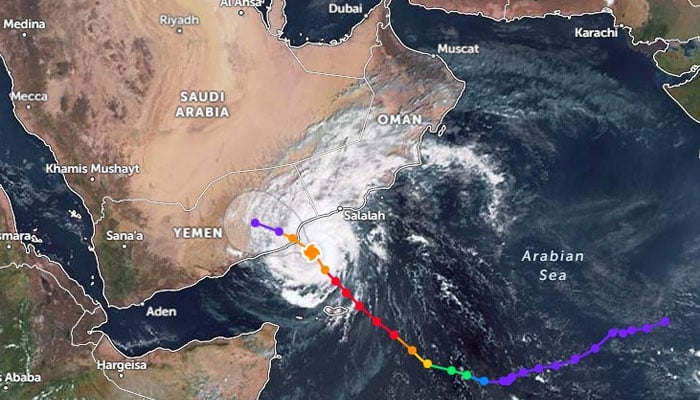
An Extremely Severe Cyclonic Storm (ESCS) named “Tej”, which has been brewing in the southwest Arabian Sea for the past few days, has continued to move northwestward toward the Arabian Peninsula’s coast.
According to the Pakistan Meteorological Department (PMD), over the past 12 hours, Cyclone Tej has been moving in a northwestward direction and is now “centred around latitude 14.4 N & longitude 53.2 °E”.
The update, which was issued today (Monday) at 10:00am (PST), also revealed that the brewing cyclone is situated “about 300km southwest of Salalah (Oman), 220km southeast of Al Ghaydah (Yemen) and 1520km southwest of Gwadar (Pakistan)”.
Additionally, the cyclone’s maximum sustained surface winds are between 150-160km/h, with gusts reaching 180km/h.
Moreover, sea conditions are currently very high, with maximum wave heights of 35ft around the system centre, according to the Met Office.
The system is expected to continue moving in a northwest direction and is likely to cross the Yemen coast, near Al Ghaydah by midnight as a very severe cyclonic storm (VSCS) with winds packing speeds of 120-130km/h and gusts reaching 150km/h.
However, it is important to note that there will be no impact on any of Pakistan’s coastal areas from this system.
According to PMD’s Daily Forecast, the weather is expected to remain dry for the next few days in most districts of Sindh, one of the coastal provinces of Pakistan.
Meanwhile, strong winds and thundershowers are likely to occur in and around some parts of Balochistan today, but dry weather is expected for the next few days.
Pakistan
PCB ‘dismisses’ objections over players support for Palestinians
Published
2 years agoon
By
LAHORE: Pakistan’s cricket team, which is currently busy participating in the ICC Men’s T20 Cricket World Cup, has shown their firm support and shared their prayers for all Palestinians suffering at the hands of Israel.
However, there have been many questions raised by Indian fans and cricket experts on the players’ constant support for Palestine asking ICC — the governing body of the game — whether such moves were allowed in the tournament.
According to sources, the Pakistan Cricket Board (PCB) rejected the objections over players’ conduct saying: “The team’s expression of solidarity was a personal decision.”
Pakistan’s national team on Wednesday, posted a picture of the Palestinian flag on their individual X, formerly known as Twitter, accounts to show that they stand in solidarity with Palestine and that they are praying for the people suffering there including children.
☮️ ☮️ ☮️ ☮️ pic.twitter.com/r8E31Jsfya
— Shadab Khan (@76Shadabkhan) October 18, 2023
— Haris Rauf (@HarisRauf14) October 18, 2023
🤲🤲🤲🤲 pic.twitter.com/2hH4Gjmyhn
— Muhammad Nawaz (@mnawaz94) October 18, 2023
Prior to this Pakistan’s wicket-keeper batsman, Mohammad Rizwan, dedicated the team’s victory over Sri Lanka to his “brothers and sisters in Gaza”.
This was for our brothers and sisters in Gaza. 🤲🏼
— Muhammad Rizwan (@iMRizwanPak) October 11, 2023
Happy to contribute in the win. Credits to the whole team and especially Abdullah Shafique and Hassan Ali for making it easier.
Extremely grateful to the people of Hyderabad for the amazing hospitality and support throughout.
Meanwhile, Indian fans and cricket experts used the team’s support for Palestine to create controversies, claiming that the national team had violated ICC rules.
Sources from PCB added that the team is “allowed to express whatever they wanted to,” and that the players “did not violate any code of conduct by the ICC or PCB”.
The Health Ministry in Gaza reports that at least 3,061 Palestinians have died and over 13,750 more have been injured as a result of Israel’s shelling.
Pakistan has categorically condemned the Israeli atrocities and called for an immediate cessation of the bombardment, which has not even spared hospitals or schools, in solidarity with its Palestinian brothers and sisters.
Even Pakistani cricket legends who are not participating in the team anymore showed their support for Palestine.
🤲🏻🤲🏻 pic.twitter.com/8i20CX2Hka
— Kamran Akmal (@KamiAkmal23) October 18, 2023
#FreePalestine pic.twitter.com/IHC74YsxQH
— Zia Ul Haq (@zuh_leftarmfast) October 18, 2023
Moreover, Pakistan is set to face Australia tomorrow (Friday) in M Chinnaswamy Stadium, Bengaluru after a few days of rest.
Supreme Court annuls trials of civilians in military courts
Sea conditions ‘very high’ as Cyclone Tej moves towards northwestward
IMF condition: ECC set to green light gas tariff hike today
Barwaan Khiladi: Kinza Hashmi discusses her role as Alia
Snap launches tools for parents to monitor teens’ contacts
WATCH: Pakistani traveller deported from Dubai for damaging plane mid-air
Learn First | How to Create Amazon Seller Account in Pakistan – Step by Step
Sajjad Jani Funny Mushaira | Funny Poetry On Cars🚗 | Funny Videos | Sajjad Jani Official Team