- CJP Umar Ata Bandial says not staying military trials.
- Chief justice also says private audios leaked.
- Bench cut down to 7 after justice Isa, Masood’s objections.
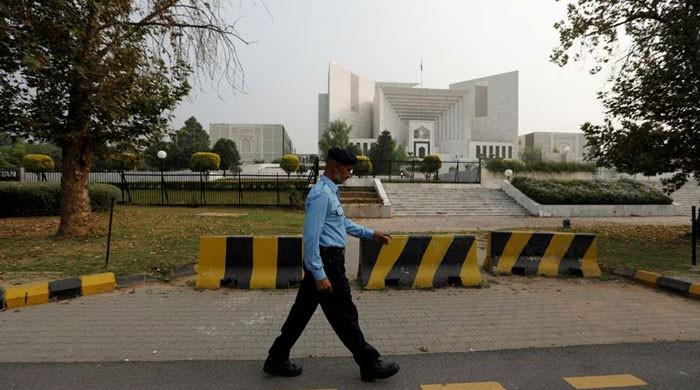
ISLAMABAD: Chief Justice of Pakistan Umar Ata Bandial said Thursday the top court would “quickly” wrap up the pleas against the trial of civilians in military courts, refusing to stay the trials.
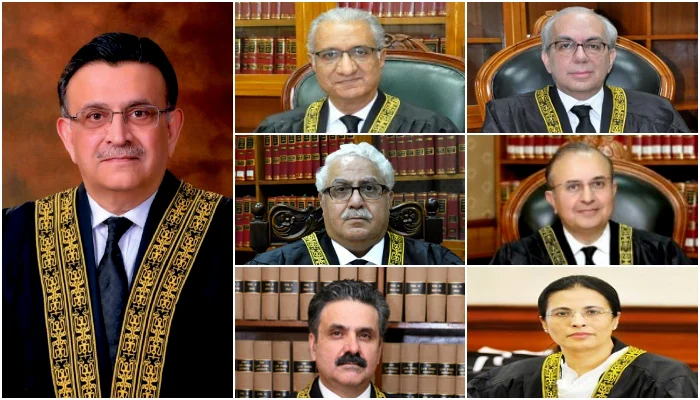
“It is not right to issue stay orders on everything,” the CJP said while heading a seven-member bench — comprising Justice Ijazul Ahsan, Justice Mansoor Ali Shah, Justice Muneeb Akhtar, Justice Yahya Afridi, Justice Ayesha Malik, and Justice Mazahir Ali Naqvi.
A nine-bench member was earlier formed to hear the pleas, but Justice Qazi Faez Isa and Justice Tariq Masood objected to the bench’s formation.
Senior Puisne Judge Justice Faez Isa said he “did not consider the nine-member bench a bench”, with Justice Masood backing him.
Justice Isa stressed that the court should first issue a verdict on the Supreme Court Practice and Procedure Act, 2023, and then constitute new benches.
An eight-member larger bench of the SC had on April 13 ordered that even if the Practice and Procedure Act, received the assent of the president, the law would not be acted upon in any manner till further order.
“I will not accept this court until a decision is issued on the Supreme Court Practice and Procedure Act. All decisions are unconstitutional until the verdict on this act is issued,” Justice Isa said, but noted that he was not recusing himself from the bench.
Responding to the judge’s concerns, CJP Bandial said he had constituted the bench in line with the law.
Then, the hearing resumed with seven members, and after hearing arguments, it was adjourned till tomorrow morning 9:30am.
The petitions separately filed by Pakistan Tehreek-e-Insaf (PTI) Chairman Imran Khan, former chief justice Jawwad S Khawaja, legal expert Aitzaz Ahsan, and Pakistan Institute of Labour Education and Research (Piler) Executive Director Karamat Ali are against the trial of military courts.
The government decided to try civilians in military courts after people allegedly belonging to the Pakistan Tehreek-e-Insaf (PTI) resorted to attacking army installations on May 9, following the arrest of their party chief.
Justice Isa ‘surprised’ at inclusion
At the outset of the hearing, Justice Isa remarked that he was surprised to see his name on the cause list for this hearing at 8pm on Wednesday (a day earlier).
“I am not a part of the bench hearing the [case related to] Supreme Court Practice and Procedure Bill so I will not make any remark about it,” the senior-most SC judge said.
He said that it should be seen what the SC rules say. Article 175/2 of the Constitution gives the court powers to conduct a hearing, he added.
Justice Isa went on to say that earlier, a suo motu notice had been fixed for hearing under his bench.
“I said in my verdict that the rules should be made in Article 184/3 of the Constitution. It was a surprise and shock that on March 31, (SC registrar) Ishrat Ali issued a circular to ignore the March 15 order of the Supreme Court,” he added.
He questioned if this was the importance of a decision made by the apex court.
He said that after this, a six-member bench was formed, which endorsed the circular and withdrew his decision.
“My friends are certainly more capable than me, but I will decide according to my faith,” Justice Isa.
He then raised the question of why no judge from the bench hearing the main case was a part of the 6-member bench for review.
The senior puisne judge mentioned that his note on the six-member bench was removed from the apex court’s website.
He said the CJP had asked him on May 16 whether he wanted to remain restricted to chamber work.
Explaining why he preferred chamber work, Justice Isa said a law had been made for the constitution of benches. The judge said he was not pointing fingers at anyone, but he was caught between the choices of joining the bench or following the law.
“I believe the law can be rejected, not suspended,” he said, in reference to the stay order on the law clipping CJP’s powers.
Justice Isa said when he was asked about chamber works, he wrote a five-page note.
“I believe that everything should be announced in open courts to avoid rumours,” he said, and read out his note in the court, which was removed from the top court’s website.
‘This is Supreme Court, not someone’s home’
Justice Masood then said he and Justice Isa could only become part of the benches once an order is issued on the law clipping CJP’s powers.
“If you do not hear this case, then what will happen of the 250 million people?” asked Khosa, at this, Justice Masood asked: “Why didn’t you think about them before?”
Then Ahsan urged Justice Isa to hear the case. In response, the judge said that he respects Ahsan, but cannot go against the law for him.
“Hear this case for the sake of your home,” Ahsan said, to which Justice Isa remarked: “This is the Supreme Court, not someone’s home.”
CJP Bandial then said that two senior judges had raised questions over the bench. He mentioned that the stay order on the law might be lifted.
The CJP told the petitioners that in line with the tradition of this court, there should be no arguments after two senior judges have raised objections.
“We will look for a solution to your case. We have constituted this bench in line with the law,” he mentioned, after which the bench exited the courtroom.
‘Military trials of civilians underway’
When the hearing resumed, Justice Shah informed the court that he was a relative of petitioner Khawaja and that if anyone had concerns about his inclusion in the bench, he would recuse himself.
At this, Attorney General for Pakistan Mansoor Awan said he had no reservations against his inclusion in the bench.
Then, CJP Bandial directed all the parties to keep the arguments short as the court was hearing the case amid summer vacations.
Khosa started his arguments by saying that Article 245 was imposed in the country.
At this, Justice Shah remarked that the federal government had issued orders for the revocation of the notification.
When CJP asked whether civilians were being tried in military courts, the lawyer responded: “Yes, military trials of civilians is underway.”
“The notification of the National Security Committee (NSC) meeting that there were irrefutable evidence for May 9 events,” Khosa maintained.
‘Tell us what the law says’
Then, Khosa read out the Formation Commanders Conference’s handout and noted that the trials of civilians would be conducted either by a colonel or a brigadier.
Justice Shah told the lawyer to stop presenting statements and come to facts. “Tell us what the law says.”
Khosa said he had requested anti-terror courts to shift civilians’ cases from military courts.
Justice Naqvi added that the anti-terror courts had jurisdiction to hear the cases filed against May 9 vandals.
The lawyer agreed and said his client is of the view that these cases should be heard by anti-terror courts.
‘Civilian laws stricter’
Justice Afridi inquired if anyone had challenged the law under which the military trials will be conducted.
At this, Justice Malik asked if the law related to military trials could be challenged. She asked the lawyers to inform the court about the rules of the Army Act and military courts.
“Tell us about the law or something solid on the basis of which the punishments are being awarded,” Justice Afridi remarked.
Justice Malik and Justice Shah asked on what basis the civilian cases in the anti-terrorism courts were transferred to military courts.
Justice Malik also mentioned that under Section 549 of the Army Act, the relevant deparment would take action against people found guilty.
Lawyer Khosa told the court that the Army Act does not mention civilians.
Then, Justice Shah said he believed civilian laws have stricter punishments than military ones.
The CJP also said that private conversations were recorded and privacy was breached.
Later, the CJP mentioned that he was not issuing a stay order on the trials of civilians in military courts. “It is not right to issue stay orders on everything.” He also sought details of the people arrested during the May 9 violence.
Ex-CJP’s plea
Former CJP Khawaja filed a petition under Article 184(3) of the Constitution, challenging the trials of civilians through military courts.
The Federation of Pakistan has been made respondent through the law, defence secretaries, and provincial chief secretaries have been made respondents in the plea.
The former chief justice submitted that the instant petition does not seek to support or attack any political party or institution, adding that it raises an important constitutional question involving fundamental rights that requires adjudication in the present circumstances.
“The petitioner has no personal interest in this case and the relief sought is for the benefit of all citizens regardless of political affiliation,” Justice (retd) Khawaja said in the petition, submitted through his counsel Khawaja Ahmad Hosain.
The former CJP prayed the apex court to declare that when ordinary courts are functioning, court martial of civilians by military courts is unconstitutional.
PTI chief’s petition
In his plea, the deposed prime minister urged the top court to declare arrests, investigation, and trial of civilians in peacetime under the Army Act and the Official Secrets Act against the Constitution.
The federation, Prime Minister Shehbaz Sharif and other ruling alliance leaders, including Nawaz Sharif, Maryam Nawaz, Asif Zardari, Bilawal Bhutto, and Maulana Fazlur Rehman were made respondents in the petition filed through advocate Hamid Khan.
Referring to the deployment of army troops in aid of civil authorities, the PTI chief implored the court to declare the imposition of Article 245 invalid and bar the authorities from arresting party workers and leaders — who are allegedly involved in ransacking state installations following his arrest on May 9.
The petition also requested the apex court to stop the trial of civilians accused of attacking defence installations in military courts, terming it a violation of fundamental rights.
Khan also accused Pakistan Muslim League Nawaz (PML-N) chief Nawaz Sharif and his daughter Maryam of creating rifts between PTI and the military by “propagating” that the latter wanted to appoint the army chief of his choice.
Moreover, the petition also prayed to the SC to take action against the “forced separation” of PTI leaders as many leaders, including Fawad Chaudhry, Shireen Mazari and others, parted ways with Khan over May 9 riots.
It further asked the apex court to hold an “impartial judicial inquiry into events leading up to the horrendous and gory events of May 9, 2023”.
Ahsan’s petition
Meanwhile, senior lawyer Ahsan challenged the trial of May 9 rioters in military courts, contending in a constitutional petition that such trials cannot take place without a constitutional amendment.
The legal expert raised a number of questions on the trial of civilians under the Pakistan Army Act, 1952 and the Official Secret Act, 1923, urging the court to declare the trials violative of Article 4, 9, 10A and 175 of the Constitution.
“Such trials for offences allegedly committed during the May 9 incidents and covered under the various FIRs [first information reports] …are ultra vires the Constitution, void ab initio and of no legal effect.
“The decision of the federal government dated May 19 rubber-stamping the decision of the Corps Commanders Conference dated May 15 to conduct such trials is liable to be set aside,” it said.
He contended that the parliament can only take the decision to try civilians for essentially civilian offenses during peacetime through a constitutional amendment and not through a resolution “which has no effect in law”.
The petitioner said the apex court ruled that the military courts formed after the 2016 attack on Army Public School (APS) in Peshawar, through the 21st Constitutional Amendment were for a limited time — under a sunset clause.
“This special dispensation was never intended to be a permanent feature of the Constitution. It finally ended in January 2019 upon the termination of the dispensation as extended by the 23rd Constitutional Amendment,” it said.
Moreover, Ahsan requested the court to declare sections 2(1)(d)(ii) and 59(4) of the Pakistan Army Act, 1952 “ultra vires” the Constitution and declare Section 94 of the Pakistan Army Act, 1952 and the 1970 Rules as a direct violation of Article 25 and 175.
Ali’s plea
Five prominent civil society members from across the country — Piler Executive Director Karamat Ali, former Karachi Metropolitan Corporation administrator Fahim Zaman Khan, Aurat Foundation director Mahnaz Rahman, educationist Prof Dr AH Nayyar, and clinical psychologist and educationist Syed Zulfiqar Hussain Gilani — had also moved the court.
The petitioners demanded the court stop the trials of civilians under the Pakistan Army Act 1952 and the Official Secrets Act 1923.
The plea mentioned that such probes and trials are against sections 2(d)(ii) and 59(4) of the army act read with sections 3, 3A, 7, and 9 of the secrets act.
The Federation of Pakistan, through secretaries of law and justice, interior, defence, chief secretaries of Punjab, Khyber Pakhtunkhwa and Balochistan have been made respondents in the plea filed through senior counsel Faisal Siddiqi.
The plea also urged the top court to permanently restrain the respondents from conducting any trial of civilian accused persons under the army act and secrets act concerning May 9 and 10 offences.