
Latest News
Regarding whether their foreign ministers spoke at ASEAN last week, China and Japan disagree.


Did China and Japan’s foreign ministers speak at last week’s ASEAN regional meeting, or didn’t they?
Last week, Japan’s Toshimitsu Motegi said he had a short chat about bilateral relations with Chinese counterpart Wang Yi when the two bumped into each other at the gathering in the Philippines.
But that was denied on Monday by a Chinese Foreign Ministry spokeswoman.
Asked about this at the regular briefing, Lin Jian replied, “I would like to stress once again that during Foreign Minister Wang Yi’s visit to Manila, there was no meeting scheduled with the Japanese side, and no brief exchanges took place on the site.”
The versions vary on the governments’ attitudes towards a severe deterioration in ties since November, when a comment about Taiwan by Japan’s Prime Minister Sanae Takaichi infuriated China.
Japan is seeking opportunities to improve relations, but China has given its neighbor the cold shoulder.
The tensions have also seeped into the economy, notably a decline in the number of Chinese tourists to Japan, and increased worry in both nations over the growth of each other’s militaries.
“As we have repeatedly pointed out, Japan is open to dialogue at all levels, and I think it is extremely important that we continue our dialogue as both Japan and China bear a major responsibility for regional peace,” Motegi said last week.
Motegi said he and Wang talked relations, but Japanese media suggested the exchange was primarily hello and niceties.
Takaichi said at a news conference Monday that the two sides are engaging in communication at many levels, including Motegi’s exchange with Wang.
Shortly after she became prime minister in November, she was asked in parliament whether a Chinese blockade of Taiwan or other military action would be a scenario in which Japan could get engaged under a concept known as collective self-defense.
The policy permits Japan’s military to assist an ally — most likely the United States — if specific conditions like the survival of Japan are met.
The Taiwan example may fit the criteria, Takaichi said. “If it involves the use of warships and military actions, it could by all means become a survival-threatening situation,” she added.
China said the comment breached red lines in its dealings with foreign countries. The government has opposed any statements or acts, including U.S. weaponry supplies to Taiwan, that assist what it calls Taiwan independence forces in its drive to seize control of Taiwan. Taiwan is an island that governs itself, yet China says it belongs to China.
Takaichi has refused to back down from her answer but subsequently told the same parliamentary committee she would steer clear of talking about particular self-defense circumstances in the future.

Pakistani boxer Usman Wazir won his 19th international world ranking fight.
Usman Wazir defeated an Indonesian boxer and qualified for the WBA Gold title.
Usman Wazir said that he has won his 19th international fight against an Indonesian boxer. He dedicates his victory to the Corps Commander Peshawar, the Pakistani Army and the police.
He said, “I dedicate my victory to the martyrs who sacrificed their lives during the ongoing terrorism in Khyber Pakhtunkhwa. The Pakistan Army has always supported me.”
Usman Wazir said, “I have qualified for the WBA Gold title, and I will announce the fight for the WBA Gold title soon.”
He said that he will try to win his twentieth fight for Pakistan and hopes for support from the government of Pakistan.
The National Electric Power Regulatory Authority (NEPRA) has suggested increased grid sharing charges for high rise structures and amendments in electricity connection rules for industrial consumers.
Proposed revisions to the Consumer Service Manual state that buildings using dedicated transformers with a capacity of over 500 kVA would be made to pay grid-sharing charges.
Even under current regulations, buildings of ground plus three storeys are not considered to be multi-storey or high-rise buildings and are hence not required to pay grid-sharing payments. The suggested revisions would alter the existing setup.
NEPRA also suggested that distribution companies may be allowed to provide multiple industrial, commercial or bulk supply connections at the same premises, with up to three feeders and combined load of up to 15 megawatts, subject to technical feasibility and availability of capacity at the existing grid station.
The proposed adjustments also affect fees for industrial and steel furnace customers, and revise the conditions for interim disconnections and reconnections.
Distribution firms may also be permitted to impose detection bills for up to 12 months for registered consumers employing fraudulent meters, changing meter readings through software or Bluetooth devices, freezing load profiles or compromising billing meters. The planned detection-bill period would be capped at six months even for domestic consumers.
The public comments on the proposed revisions have been invited by NEPRA and stakeholders have been given 30 days’ time to offer their views till October 25.The National Electric Power Regulatory Authority (NEPRA) has suggested additional grid-sharing costs for high-rise structures and amendments in electricity connection rules for industrial consumers.
Proposed revisions to the Consumer Service Manual state that buildings using dedicated transformers with a capacity of over 500 kVA would be made to pay grid-sharing charges.
Even under current regulations, buildings of ground plus three storeys are not considered to be multi-storey or high-rise buildings and are hence not required to pay grid-sharing payments. The suggested revisions would alter the existing setup.
NEPRA also suggested that distribution companies may be allowed to provide multiple industrial, commercial or bulk supply connections at the same premises, with up to three feeders and combined load of up to 15 megawatts, subject to technical feasibility and availability of capacity at the existing grid station.
The proposed adjustments also affect fees for industrial and steel furnace customers, and revise the conditions for interim disconnections and reconnections.
Distribution firms may also be permitted to impose detection bills for up to 12 months for registered consumers employing fraudulent meters, changing meter readings through software or Bluetooth devices, freezing load profiles or compromising billing meters. The planned detection-bill period would be capped at six months even for domestic consumers.
ISLAMABAD: NEPRA has floated the proposed revisions for public comments and has given 30 days time to the stakeholders to express their opinions by October 25.
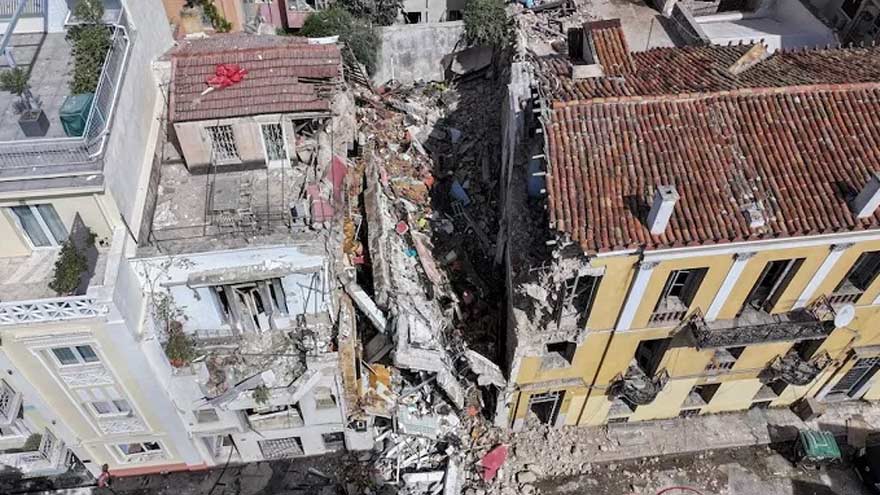
– Six people have died after a two-storey residential building in a tourist area of central Athens collapsed, the Greek fire brigade said on Saturday, following an explosion that the mayor said was likely linked to gas infrastructure.
The explosion killed four Americans, US officials said.
Emergency crews in heavy gear and red helmets, assisted by rescue dogs, cameras and sensors, found the bodies of six people, fire brigade spokesman Vassilis Vathrakogiannis said in a televised briefing.
They were looking for an elderly couple who lived in one apartment and four tourists who were staying in another as they removed debris from the building.
The fire brigade’s crime investigation unit was also on site to identify the cause of the blast after reports of a gas smell in an area that is home to hotels and short-term rentals.
The tourists, two American couples, had been expected to catch a flight from Athens airport at 3 p.m. on Friday but did not show up, a police source said.
Ambulances stood by on Saturday to take the bodies to the hospital for identification.
“I am deeply saddened to learn of the death of four American citizens in yesterday’s explosion in central Athens,” Kimberly Guilfoyle, the US ambassador to Greece, posted on X.
The blast destroyed the building in Plaka, near some of Athens’ most visited sites, including the Acropolis and the Temple of Zeus, damaging nearby houses, shops and cars and sending rubble and broken glass as far as three blocks away.
The building was reduced to twisted metal, shattered tiles and concrete, strewn with household items and clothing.

Wazir wins 19th world ranking fight for Pakistan

NEPRA suggests grid sharing charges for high rise buildings

Six dead in Athens building explosion, four Americans among the victims

ICC board meeting in India: Mohsin Naqvi gets invitation

23 people have died during the monsoon as rain-related incidents plague Punjab and KP.

Govt dedicated to resolving Balochistan issues: Dar
-
 Latest News4 months ago
ICC board meeting in India: Mohsin Naqvi gets invitation
-
 Latest News2 months ago
23 people have died during the monsoon as rain-related incidents plague Punjab and KP.
-
 Business2 months ago
Govt dedicated to resolving Balochistan issues: Dar
-

 Latest News1 month ago
‘Self-Reliance in Digital ID’: NADRA launches locally produced QR code-based National Identity Card
-

 Latest News2 months ago
Pakistan making rapid progress in robotics, AI: Shaza Fatima
-

 Entertainment4 months ago
Interim bail given to YouTuber Rajab Butt in gambling app marketing case
-

 Latest News2 months ago
After a divorce, LHC decides that women who have been harmed by their spouses get their dower.
-

 Latest News1 month ago
Turkish FM, Dar discuss regional trends, bilateral connections