
Pakistan
Why violence against women continues unabated despite presence of laws


Over the last few years, there has been a surge in the reported cases of domestic violence across Pakistan. Studies show that most marriages in our society are based on toxic relationships, often involving physical and emotional abuse. This, in particular, pertains to women in the country and even if they try to open up to their families about being abused, they are often sent back to their abusers in a bid to “save the household”.
Many a time, victims of domestic violence are told that “everything would be fine once a baby is born”. In hopes of making the situation better, women keep having children, but the cycle of domestic violence rarely stops.
As a result, a toxic, abusive marriage — which could easily be ended within a few months — lingers on and women have to stay with their abusers for years, only for the sake of their children. In doing so, not only is the victims’ life is ruined but children also suffer equally while being forced to live in an abusive household.
Grim numbers
Recently, a detailed report documenting incidents of domestic violence in the last three years was presented before the National Assembly of Pakistan. According to the document, a total of 63,367 cases of violence against women were registered with the police over the last three years. Meanwhile, between 2019 to 2021, 3,987 women were killed as a result of domestic violence.

The report, citing police records, further showed that a total of 5,171 cases related to physical abuse and torture were registered during this period, while 1,025 women were subjected to honour killings and another 103 women became victims of acid attacks. Similarly, a total of 10,517 rape cases and 643 incidents of gang rape were registered with the police during the aforementioned period.
Prevalent in all socioeconomic classes
The statistics show that despite the presence of domestic violence laws in the country, women are still not safe. Such cases are also not confined to specific socioeconomic classes, as women belonging to all backgrounds have witnessed intimate-partner violence, which has even led to murder. A few examples include the Noor Mukadam and Sarah Inam murder cases, as well as the ongoing domestic abuse case of Syeda Aliza Sultan, who recently submitted evidence of domestic violence in a court against her ex-husband, renowned Pakistani actor Feroze Khan.
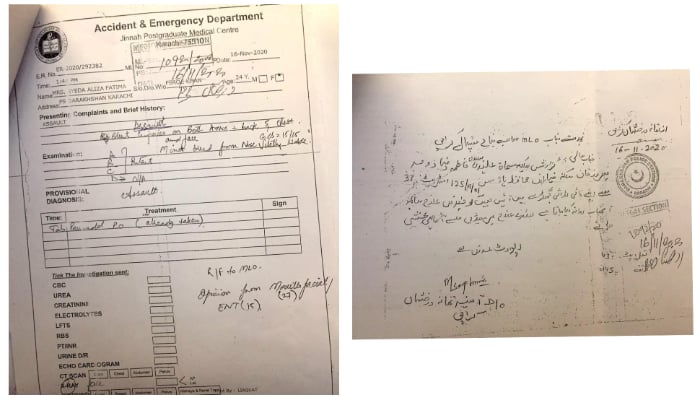
According to Aliza, over the last four years, Khan allegedly subjected her to physical violence several times while also torturing the couple’s son, Sultan. She also submitted her medico-legal reports and images before the court to prove that she was assaulted by him.
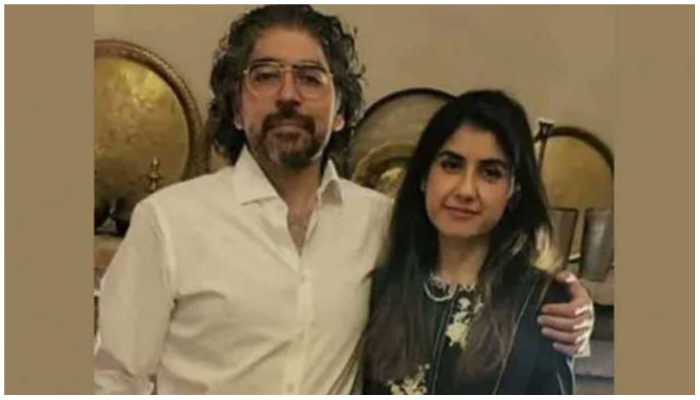
Shedding light on such incidents, Pakistani lawyer and legal expert Sara Malkani reiterated that cases of violence against women are rampant in all socioeconomic classes and even those who are highly educated or belong to respected families are not immune to it. The cases of Aliza Sultan, Noor Mukadam, and Sara Inam serve as relevant examples.
“It doesn’t matter whether you belong to the upper class, lower class, or the middle class and it makes no difference if you are educated or not. Cases related to domestic violence, rape, and honour killings are found everywhere in the country,” Malkani told Geo.tv.
Fatima TuZara Butt, an Islamabad-based lawyer who specialises in cases related to women including domestic violence, meanwhile, said that such cases continue because, in Pakistani society, a girl’s parents hold the belief that once their daughter is married, she should stay obedient to her husband, otherwise no one would accept her.
“Often when a victim approaches her family and expresses her desire to return to her home, her father and brothers refuse to take her back under the pretext of preserving the family’s honour,” Butt said while speaking to Geo.tv.
Tip of the iceberg
Sara Malkani went on to say that “we are only aware of reported cases”, but thousands of victims never go to the police to report their ordeals. “The statistics, therefore, do not portray the real picture.”
She maintained that while the focus is largely on punishment for the crimes committed against womenfolk, it is the duty of society to also talk about prevention so that such cases do not happen in the first place.
“We, as a society, have to understand that the root cause of these horrible incidents lies in patriarchy, so there is a dire need to address this issue and stop such cases from happening,” she said, adding that accountability was largely missing from the Pakistani culture.
“We mostly see that there is no accountability if someone does something wrong and they won’t be answerable to anyone. On the other hand, while we talk about accountability, many a time women approach the police and court to seek security. But our state’s system in this regard is very weak. The police don’t respond,” she maintained.
Butt said that the reason why cases of domestic violence are increasing despite the presence of law is because of the patriarchal system.
“If a man is subjecting his wife to domestic abuse, the victim seldom finds any support from other family members,” she said, adding as a result, they often have to become victims of domestic violence at the hands of their husbands.
Owing to this social stigma, females don’t want to report the cases, she added.
“Even when they muster the courage to do so, police officials often discourage the victims from proceeding with the case and suggest they go home and resolve family matters within the family,” the lawyer stated.
Need for early intervention
Malkani, while citing the example of other countries, said that around the world, it has been established that such assaults should be dealt with in a timely manner to save women from being killed.
“If the response is timely, it is possible to prevent serious cases. But we don’t see such a response, even though the awareness regarding these matters has increased a lot,” she said, adding that most domestic violence victims require immediate protection.
“Their first question is mostly about how they can protect themselves because they fear the abuser would follow them even if they leave their homes and how they can protect themselves in such a situation. But [women should be aware that] the Sindh Domestic Violence Act, for instance, has a provision that allows women to seek protection from the court, while Punjab’s law also has this provision.”
She said that if the laws are properly implemented by the court and police, then several women and children can be provided proper protection. “We can see that this law was passed nine years ago in Sindh, but the courts don’t understand it properly because when we file an application with the magistrate, they still neither understand nor have the sensitivity that they are supposed to issue such an order immediately and for police to instantly act upon them,” she said.
Answering a question related to how the public has a lack of trust in the police and the country’s judicial system, Malkani cited the example of the Noor Muqadam murder case and said that it was an exception because the speed with which the trial proceeded and timeliness of the criminal’s conviction has not happened in other cases, adding that other cases of a similar nature would not get the kind of publicity that Noor’s case received.

“When there are so many cases, the media and public wouldn’t approach it the same way. Trust is an issue here. Even in a city like Karachi — where so many sensitisation training sessions have been conducted from time to time and the civil society has also done a lot of work to create awareness — whenever a woman goes to the police station to lodge a complaint related to domestic violence, they are often discouraged to register a first information report (FIR) and are instead suggested to “compromise” and continue living with the abuser.”
Can domestic violence law protect women after divorce?
In cases where a couple has had an abusive relationship that ended up in a divorce, after which several cases were filed in a court of law by both parties involved and the victim is threatened regarding the custody of her children, Malkani said that the victims can still register an FIR because there is no statute of limitation in the law regarding that.
“I have also dealt with a case where the proceedings for khula (woman’s demand for a divorce) and domestic violence were tried simultaneously. Therefore, there is room [for filing a report] in the law even after a woman has divorced,” she said, adding that cases like that should be brought to the forefront where even if the woman leaves the husband and opts for divorce, the proceedings for domestic violence can also take place simultaneously and the trail can be initiated. “This should happen and the law is open to it.”
Butt, on the hand, said that Pakistan’s government has passed legislation to deal with cases in which women are subjected to violence at home, on the streets or anywhere else.
“The laws exist to deal with these cases. However, its implementation is weak because women don’t take a stand. They fear that if they take any action, they might be kicked out of their homes and might hurt their honour. Such cases usually remain buried due to the aspect of ‘honour’ associated with it,” Butt said.
She further shared that the length of these cases also makes redressal a challenge.
“Women have to fight for years to prove domestic violence; they have to visit the court numerous times, hire a lawyer and pay their fees. On the other hand, Pakistan’s justice system is also very slow and by the time a case is heard in the court, a judge may get transferred or take a leave. A lawyer may not be available or a strike may take place in the court,” she shared.
Keeping these scenarios in mind, Butt informed, there is no time limit to clarify when the case would get resolved or whether the court is bound to issue a verdict soon and punish the abuser.
Butt also pointed at a woman’s lack of financial independence, as money is required to pay for the case to be processed and hire a lawyer which can be difficult for women.
“Women who approach the court are judged by our society, as they consider them to be very unabashed for taking the decision to confront their abuser,” she said, adding that women are labelled as “bold and characterless”.
“Women feel vulnerable and give up on reporting such cases. All these factors are interlinked when it comes to the lack of implementation of laws and legislation,” Butt shared when commenting on the issue of implementation.











Supreme Court annuls trials of civilians in military courts

Sea conditions ‘very high’ as Cyclone Tej moves towards northwestward

IMF condition: ECC set to green light gas tariff hike today

Barwaan Khiladi: Kinza Hashmi discusses her role as Alia

Snap launches tools for parents to monitor teens’ contacts

WATCH: Pakistani traveller deported from Dubai for damaging plane mid-air

Learn First | How to Create Amazon Seller Account in Pakistan – Step by Step

Sajjad Jani Funny Mushaira | Funny Poetry On Cars🚗 | Funny Videos | Sajjad Jani Official Team
