
Latest News
FCC says it is not bound by Supreme Court rulings

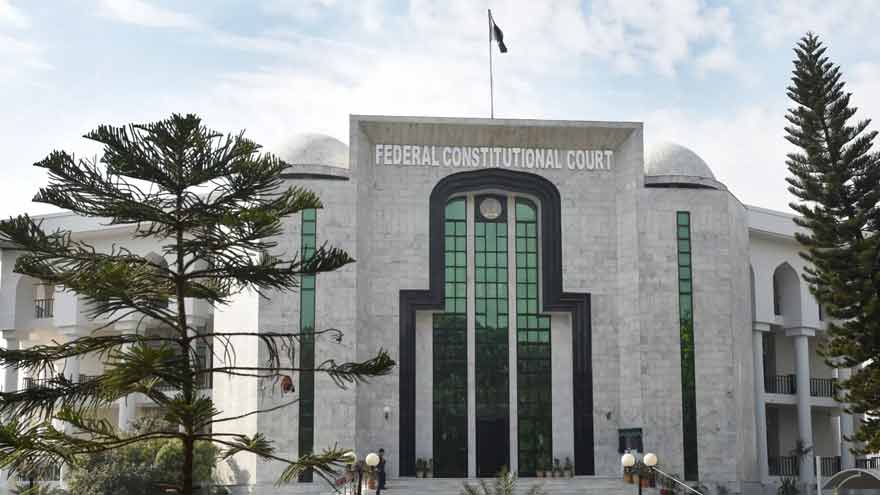
The Federal Constitutional Court (FCC) is not bound by the decisions of the Supreme Court but can ask for direction from its judgements, the court declared, defining the legal position of judicial precedents and prescribing tight conditions for filing review petitions.
The Federal Constitutional Court has said in its opinion that Supreme Court judgements are solely of persuasive value for the FCC. The constitutional court, however, may follow a legal precedent set by the Supreme Court, if it is in accordance with law and Constitution.
The court also made it very clear that the scope of review authority is quite narrow and only extends to particular circumstances.
The court held that a review petition might be entertained only if there was an error apparent on the record or an omission which causes a miscarriage of justice. Review petition is not a device to re-argue a case or to get a fresh hearing of the matter.
The court said that in review procedures it does not retry the whole case, but looks to see if there is an obvious error in the record of the initial case.
The FCC also cautioned against routine filing of review petitions, advising litigants and counsel to approach the court for review only when there exist genuine and legally valid grounds.
It cautioned that frivolous or malicious review petitions could entail fees of Rs25,000 or more.
It also said that an Advocate-on-Record who files frivolous or malicious review petitions could also be subjected to disciplinary punishment.
The Advocate-on-Record or the party involved shall be obliged to file a certificate prior to filing a review petition indicating the reasons on why review is sought.
The court further directed to deposit Rs50,000 as security for hearing of a review petition.
In the event of dismissal of a review petition or its declaration frivolous or malicious, the deposited security may be lost, says the Federal Constitutional Court.
The ruling further said review petitions could be handled through distribution without an oral hearing in certain instances.
FCC Clarifies Scope of Right to Appeal
The Federal Constitutional Court also defined the procedure for appeals against decisions of High Courts under Article 199 of the Constitution.
It said that permission from the FCC was necessary under Article 175F(1)(c) prior to initiating an appeal against a High Court judgement issued under Article 199.
The court emphasised that leave to appeal is not an appeal as of right. An application becomes an appeal only once leave has been granted by the court.
It further clarified that the dismissal of a leave-to-appeal motion does not mean that the High Court’s decision has been affirmed.
The court said it did not have to give extensive grounds when refusing an application for leave to appeal.
It noted that a non-speaking ruling or an order without specific rationale does not per se be a foundation for filing review petition.
When the court is at the leave-to-appeal stage it looks at whether there is a legal question worthy of examination or whether intervention is required to prevent a miscarriage of justice.
FCC rejects Balochistan Trading Company’s review petition
The Federal Constitutional Court dismissed a review appeal submitted by Balochistan Trading Company and directed for forfeiture of the security deposited by the company in the meanwhile.
The court found that the firm had not identified any error obvious on the face of the record that would warrant a review of the earlier decision.
The court noticed that the review petition was reiterative of the arguments advanced in the proceedings.
Therefore, the company’s petition for the restoration of its lease and possession was dismissed.

Lahore High Court (LHC) has stayed an order instructing Punjab Information Minister Azma Bokhari to appear in person for cross examination on her statement in the fake video case and stayed execution of her arrest warrants.
The court also directed the trial court to proceed against the remaining witnesses in the case.
Azma Bokhari filed a petition before Justice Abher Gul Khan of the Lahore High Court. The petitioner’s counsel Ali Zaid Bokhari and Barrister Musa argued in the court that the matter related to the bogus film against the province information minister was under trial.
Azma Bokhari, a top government official, had security concerns and it was difficult for her to appear personally before the trial court, the lawyers contended.
The court was notified of the trial court summoning Azma Bokhari for cross-examination on her statement. However, she was issued arrest warrants for her non-appearance despite the case being sub judice in the Lahore High Court.
The petitioner’s lawyers argued that the arrest warrants were issued illegally and urged the top court to set out the order asking for her personal appearance.
They also requested permission to cross-examine Azma Bokhari using a video link rather than being physically present before the trial court.
The Lahore High Court, after hearing the arguments, delayed the order of Azma Bokhari’s appearance in person for cross-examination and barred the authorities from executing her arrest orders.
The high court also directed the trial court to record the statements of other witnesses in the case and go further in so far as those witnesses are concerned.

President Donald Trump’s White House has been preparing for months for a possible Democratic takeover of Congress, developing plans to continue advancing major parts of his agenda through executive power while bracing for investigations of his administration, according to a White House official and two people familiar with the plans.
Three people, who spoke on condition of anonymity, said senior officials including deputy chief of staff Stephen Miller and budget director Russell Vought have been meeting with the White House Counsel’s Office since April to identify executive actions on immigration, tariffs, housing costs and federal spending that Trump could take without congressional approval.
The White House insider said White House counsel Will Scharf and his team are also looking at “what Trump can legally do on his own, where he could push the limits of his authority and how to defend those decisions in court.”
The preparation highlights a contradiction of Tuesday’s midterm elections: Democrats would take control of Congress and have the power to investigate Trump, stop legislation and rein in his spending priorities. But Trump would hold vast executive power over trade, foreign policy and the federal bureaucracy that he has already utilised forcefully in his second term.
“If we lose the Congress, I think I’ll be able to veto for a month or two and then start making deals with the Democrats,” Trump stated.Trump said he would be “Mr. Veto,” in a portion of an interview released Sunday on the New York Post’s Pod Force One podcast. “And we’ll probably make deals at some point.
To wrest the thin 218-214 and 53-47 Republican majorities in the US House of Representatives and US Senate, Democrats need a net gain of four seats. Opinion polls suggest the Democrats have the edge to take the House, but the Senate is too close to call.
For the past month Trump has been holding rallies around the country trying to maintain Republican control of Congress, even as advisors discreetly prepare for a much different political scenario in 2027.
The White House dismissed the potential of Republican losses and accused the media of perpetuating a false narrative.“This administration and commonsense Republicans will continue to secure our borders, restore law and order, putting more money back into the pockets of hard-working Americans and deliver wins for the American people,” White House spokeswoman Lauren Bis said.
The executive actions under consideration include increased levies on imports of essential minerals and wind turbines, tougher limits on visas for international students and temporary foreign workers, and steps to reduce housing and building prices, the White House official said.
One of the people familiar with the planning said federal departments had submitted ideas and legal studies of actions the administration may take on its own.
Vought, whose U.S. Office of Management and Budget supervises federal spending, is reviewing whether goals may go ahead with money already approved by Congress, two of the sources said.
He also wants to amend federal grant regulations to allow political appointees greater say in which government programs get taxpayer dollars, they added, potentially giving the White House more control over federal spending without obtaining legislative permission.
The White House official said Trump has been briefed on the preparations and has been included in discussions about them.
Asked how comfortable Trump would be operating through executive authority with a Democratic Congress, one of the people answered “very comfortable.”
GOVERNING WITHOUT A CONGRESS
Since returning to the White House in January 2025, Trump has already tested the limits of presidential power, using his executive authority to impose sweeping tariffs, ramp up immigration enforcement, shrink the federal workforce and pursue foreign-policy goals, including the war against Iran, without congressional approval or new legislation.
The one big exception was Trump’s enormous package of tax and expenditure cuts, passed by the Republican-controlled Congress and signed into law by the president in July 2025.Nathan Gonzales, editor at Inside Elections, which provides nonpartisan political analysis, said President Trump has virtually ignored Congress in the previous two years and attempted to do as much as possible through executive orders and executive power. “If there are Democratic majorities, I think he’ll just continue.”
Trump has declared national emergencies multiple times to extend his power to act without new laws. Trump could veto any such move, and Congress would need two-thirds majorities in both chambers to override him.
A Democratic Congress still might be a huge roadblock.
And if Democrats gained control of the Senate, they could block Trump’s judicial and executive-branch appointments, including any Supreme Court nominee.I would expect them to be extremely loath to confirm any of the president’s appointments,” said Andrew Busch, a public policy professor at the University of Tennessee, Knoxville and author of a history of midterm elections.
Democrats also might kill legislation Trump supports. But Trump can veto Democratic legislation he doesn’t like, and Democrats likely won’t have enough votes in the House to override him.
Courts can strike down executive measures that go beyond what Trump is legally allowed to do. The White House aims to obtain legal views from the Justice Department on what Trump can do without Congress and how to defend such measures if they are sued, said one of the sources.
DEMOCRATIC PROBES
But there is one obstacle that cannot be met through presidential action — congressional enquiries.
Senior House Democrats and committee aides have talked of using hearings, subpoenas and document requests to investigate whether Trump has used his presidential position to help himself, allies or donors, Reuters has previously reported.
All three people said Trump aides have spent months getting ready for that possibility.
White House lawyers have been advising political appointees and agency heads on how to respond to congressional enquiries, document requests and subpoenas, one person said. Officials have been warned to be careful what they put in writing.
They also wanted a Justice Department ruling that may allow Trump to claim executive privilege to insulate communications with private advisers from congressional inquiry, according to the individual.
Explore Topics

Sui Northern Gas Pipelines Limited (SNGPL) has extended the prohibition on new home gas connections indefinitely since gas shortages and supply problems have been on the rise, sources stated on Sunday.
Sources said the prohibition has been extended to commercial connections, including those for tandoors and hotels, from the current month.
Sources say thousands of users are still without any gas connections despite paying urgent processing cost.
They stated the supply of regasified liquefied natural gas (RLNG) had been affected and the gas deficiency in the existing distribution system had also gone higher.
As winter begins, demand for petrol has risen many times and it is getting harder to keep supplying even current home customers.
SNGPL, however, has chosen to extend banning of new domestic connections for an indefinite period despite the rising demand.
Gas firm officials claimed the Petroleum Ministry had enforced the embargo and the resumption of new connections was probable only once the Iran-US crisis comes to an end.

LHC suspends Azma Bokhari’s appearance order, halts arrest warrants in fake video case

Trump White House maps path to govern without Congress if Democrats win

SNGPL extends ban on new domestic gas connections indefinitely

ICC board meeting in India: Mohsin Naqvi gets invitation

‘Self-Reliance in Digital ID’: NADRA launches locally produced QR code-based National Identity Card

23 people have died during the monsoon as rain-related incidents plague Punjab and KP.
-
 Latest News6 months ago
ICC board meeting in India: Mohsin Naqvi gets invitation
-
 Latest News3 months ago
‘Self-Reliance in Digital ID’: NADRA launches locally produced QR code-based National Identity Card
-
 Latest News3 months ago
23 people have died during the monsoon as rain-related incidents plague Punjab and KP.
-

 Latest News2 months ago
Turkish FM, Dar discuss regional trends, bilateral connections
-

 Business4 months ago
Govt dedicated to resolving Balochistan issues: Dar
-

 Latest News3 months ago
Pakistan making rapid progress in robotics, AI: Shaza Fatima
-

 Entertainment6 months ago
Interim bail given to YouTuber Rajab Butt in gambling app marketing case
-

 Latest News3 months ago
After a divorce, LHC decides that women who have been harmed by their spouses get their dower.