Connect with us

Latest News

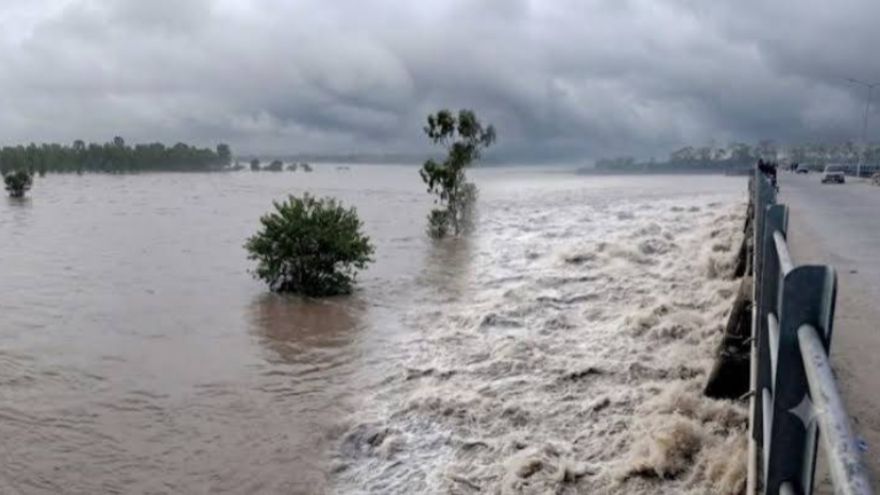
Ferozewala: Flooding worsens as breach in embankment cuts off communities

Published

on

Rescue operations by Rescue 1122, Alkhidmat Foundation and welfare wing of Pakistan Markazi Muslim League are underway. The volunteers are evacuating women, children and elderly folks using boats. Relief teams are also distributing ready-made meals, dry rations, clean drinking water and other essentials.

A temporary relief and medical camp has also been set up to distribute free medicines, first aid, drinking water and food. The group claimed thus far it has moved some 2,000 people to safer locations.

Officials said they were employing drones to monitor the water situation but residents criticised officials for not giving them enough warning. The damage may have been far less if the seasonal drains were desilted earlier and encroachments eliminated, they claimed.

Locals also alleged no top government or administrative officials had visited the destroyed towns, and said relief operations had been primarily undertaken by charitable organisations and emergency agencies.

The Meteorological Department has predicted more monsoon rain and residents are afraid that the situation may develop further if the already flooded areas are again hit by a heavy spell of rain.

Continue Reading
Click to comment

Leave a Reply

Your email address will not be published. Required fields are marked *

Business

S&P Global expects State Bank to remain cautious on monetary policy despite economic benefits

Published

on

By

Pakistan’s improving economic indicators are unlikely to trigger an immediate shift in monetary policy as inflation and external risks continue to weigh on the outlook and the State Bank of Pakistan (SBP) is expected to maintain a cautious approach, according to a new report by S&P Global Market Intelligence.

S&P Global Market Intelligence’s recent assessment indicates that the central bank’s decision to hold the policy rate at 11.5% was a wise move to safeguard macroeconomic stability.

The report stated Pakistan’s economy has shown indications of recovery but inflation remains over the central bank’s intended range, restricting the possibility for significant monetary easing.

S&P Global has warned that rising tensions in the Middle East, global commodity price volatility and the increasing impact of climate change continue to pose major risks to Pakistan’s economic prospects.

According to the analysis, Pakistan’s economy is expected to increase by 3.5 percent for the fiscal year 2027, aided by strengthening macroeconomic conditions and a stronger external sector performance.

It also estimates that the country’s foreign exchange reserves might touch $19.5 billion by December 2026, mostly backed by resilient workers’ remittances and reasonably limited current account deficit.

Higher remittance inflows are likely to enhance Pakistan’s external financing position and help reduce balance of payments concerns, S&P Global said.

S&P Global Principal Economist Ahmed Mobeen commented on the prognosis, stressing the importance of fiscal discipline, especially considering the country’s debt service obligations.

Economic conditions have improved, but “the State Bank will likely continue to give priority to price stability and watch closely for global and domestic risks before making any further policy changes”, he said.

Continue Reading

Business

Mideast tensions ease, crude oil prices decline, stocks sag on Wall Street

Published

on

By

  • Stocks on Wall Street wobbled to a mixed finish Monday as oil prices dipped after the U.S. and Iran suspended their strikes as work resumed to restart discussions to end the war.

The S&P 500 was up less than 0.1% after spending most of the day bouncing between minor gains and losses. The benchmark index was coming off two straight weekly losses. The Dow Jones Industrial Average increased 0.5 percent and the Nasdaq composite lost 0.2 percent for its fourth straight loss.

The three main stock indexes are on track to post monthly declines. That would be a second straight monthly decline for the S&P 500 and Nasdaq.

Oil prices turned lower after a week of gains driven by a significant rise in conflict between the U.S. and Iran that raised fears about global oil supplies. Brent crude, the worldwide benchmark, lost 6.3% to end at $85.87 a barrel for October delivery. Last week prices shot up over $100 a barrel before dropping again.

U.S. crude oil for September delivery dropped 7.5% to settle at $82.61 a barrel.

The confrontation between the U.S. and Iran has severely limited, and at times stopped, transportation through the critical Strait of Hormuz. That has sent ripples through the global economy. Gasoline prices have soared and transportation costs are going up for most commodities, and firms usually pass those expenses along to households.

Trading was shaky, with a mix of large firms leading to gains and losses, with technology companies responsible for much of the market swings.

Nvidia sank 5% while Micron Technology lost 2.3%. Microsoft shares jumped 1.9%, while Apple added 1.2%. They are all among the most valuable corporations in the world, and those lofty values give them considerable sway over the broader market’s path.

Most businesses in the S&P 500 rose, but the mix of gains and losses among a range of those companies had more influence in pushing and pulling the market. Communications stocks were among Monday’s winners. Shares of Alphabet, the parent company of Google, increased 2.1%. Charter Communications shares jumped 6.7% while Comcast shares climbed 2.3%.

Credit card issuers and payment processors also profited. American Express was up 2.8%, Capital One Financial added 2.1%, Visa jumped 1.9% and rival Mastercard was up 2.2%. Shares of Chinese memory chip company CXMT jumped on their Shanghai debut. The corporation catapulted to become the most expensive listed company in China, with a projected market value of 3.3 trillion yuan (almost $490 billion).

The S&P 500 was up 1.20 points at 7,413.18. The Dow added 262.83 points, to 52,210.08, while the Nasdaq fell 43.74 points, to 24,932.08.

It’s a busy week ahead on Wall Street with a number of potentially mark-moving developments on the economy and company profits. Consumer confidence reports are coming Tuesday and inflation Thursday.

“This is a week with more than its share of potential surprises, good and bad,” said Chris Larkin, managing director, trading and investing, with E-Trade from Morgan Stanley.

The primary focus will be the Federal Reserve with an announcement on its interest rate policy Wednesday. The central bank has had to deal with the effects of growing inflation, as the U.S. war with Iran continues. It also faces a fresh round of U.S.-imposed tariffs worldwide that might add to its inflation troubles.

Wall Street gives a roughly one-in-three probability the Fed will raise rates at its meeting this week. Raising rates makes borrowing more expensive, which can help cool inflation and hinder economic growth.

The central bank has held rates stable throughout 2023 as it analyzes the course of inflation and its impact on the economy, but Wall Street is wagering on at least one rate hike before the year ends. Inflation is still too high, which is hurting people, and fuel prices have been a particular strain on budgets and expenditure. Higher gasoline prices are pinching household budgets and that may mean cutting back on other things such as clothes and travel.

Investors are looking to the next round of corporate earnings for signs of consumer strain and if the yearlong rally in stock prices across Wall Street is supported by profits and profit-growth predictions.

Investors will also be digesting a strong wave of corporate earnings this week. Many of those studies could shed further light on the health of different parts of the economy. Paint and coatings producer Sherwin-Williams, airplane builder Boeing and payments processor Visa are scheduled to disclose their latest results on Tuesday.

Starbucks and Chipotle are reporting earnings Wednesday. Technology companies have come under particular scrutiny since their huge profits during the year have fueled Wall Street’s record run. Microsoft is due to report earnings on Wednesday. Apple and Amazon (which has a booming cloud services sector and is AI-focused) release earnings Thursday.

Continue Reading

Latest News

PMD warns of urban flooding Heavy monsoon rains will strike Pakistan from July 29

Published

on

By

Pakistan’s Met Department (PMD) has anticipated a new bout of heavy monsoon rains in the country from July 29 and has asked all concerned agencies to stay alert to probable weather-related catastrophes.

Upper and central sections of the country will continue to come under the influence of monsoon currents carrying moisture from the Arabian Sea and the Bay of Bengal, said the PMD. A robust weather system from the west is likely to penetrate most parts of Pakistan from August 1, resulting in intensified rainfall.

The department said rain and thunderstorms are predicted to occur intermittently in Azad Jammu and Kashmir from Tuesday night to August 5 with heavy to extremely heavy rainfall at isolated places.

Heavy rain with gusty winds and thunderstorms from July 29 to August 4 are also expected in Islamabad, Rawalpindi, Murree, Galliyat and other parts of Punjab.

Rainfall is forecast in southern Punjab encompassing Bahawalpur, Bahawalnagar, Rahim Yar Khan, Multan, Vehari, Khanewal, Lodhran, Muzaffargarh, Kot Addu, Dera Ghazi Khan and Rajanpur from July 31 to August 3.

Most of the districts of Khyber Pakhtunkhwa are anticipated to receive rain, thunderstorm with isolated heavy precipitation from July 29 to August 5. Gilgit-Baltistan is projected to receive moderate to heavy rains from Tuesday evening to August 6.

The PMD also predicted rain with heavy rains at isolated areas in eastern and southern Balochistan from the evening of July 31 to August 3. Several districts of Sindh are likely to receive thunderstorm and rain from the evening of July 31 to August 2.

The weather agency had predicted urban flooding in Islamabad, Rawalpindi, Peshawar, Nowshera, Gujranwala, Gujrat, Sialkot, Lahore, Multan and Faisalabad between July 30 and August 4.

Low-lying districts of Sindh include Nawabshah, Sukkur, Shaheed Benazirabad, Hyderabad, Thatta, Badin, Sanghar, Khairpur, Mithi, Mirpurkhas, Umerkot, Tando Muhammad Khan and Tando Allahyar are all expected to be inundated.

The PMD also cautioned about landslides in hilly areas of upper Khyber Pakhtunkhwa, Gilgit-Baltistan, Murree, Galliyat and Kashmir from July 30 to August 5. It also warned of flash floods in hill torrents in Kashmir, Murree, Galliyat, northeastern Punjab, Islamabad, Khyber Pakhtunkhwa, Gilgit-Baltistan and northeastern Balochistan.

The government warned of damage to flimsy dwellings, solar panels, power poles and billboards caused by strong winds, heavy rain and lightning.

The PMD recommended people, visitors and travellers to avoid needless travel during the poor weather and follow preventive measures. Farmers have been advised to prepare agricultural activities as per the forecast while livestock owners have been asked to guarantee safety of their animals.

All concerned authorities have been advised to remain alert and take preventive steps so as to effectively respond to any emergency situation.

Continue Reading

Trending