
Business
Pakistan must focus on fiscal discipline, export growth and private investment: FinMin Aurangzeb

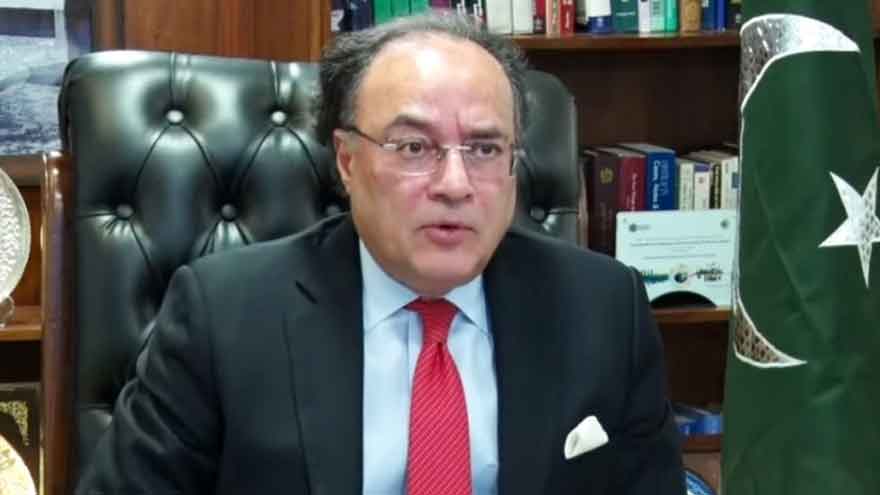
ISLAMABAD: Finance Minister Muhammad Aurangzeb said Pakistan was on path of going from economic stability to sustainable development and stressed the need for fiscal discipline, boosting exports and promoting private investment for longterm economic improvement.
Addressing a virtual event of the Pakistan Banks Association, the finance minister said the country needed financial innovation that could cut the cost of doing business and bring more people into the formal economy.
He argued that electronic assets should be integrated into the financial system based on their real economic benefits and their ability to facilitate company activity.
Aurangzeb said Pakistan’s move from economic stability to sustainable development needed fiscal discipline, export expansion and more private sector investment. Digital innovation should assist to offer financial services to more people and make corporate operations more efficient, he said.
The finance minister noted the use of deposit tokens by institutional customers on blockchain networks as a real-world example of digital financial innovation.
“The BIS’s Project Agorá was looking at tokenised bank deposits, and the central bank was looking at possibilities for cross-border payments through deposits,” he stated.
Muhammad Aurangzeb said banks play a key part in safeguarding cash and addressing hazards related with digital technologies. He said banks were also crucial in ensuring that services are effectively delivered to consumers.
He underlined that the legal framework should distinguish between different forms of electronic assets and the economic activity related to them.
Under the Virtual Assets Act 2026, a legislative framework had been formed in Pakistan and the Pakistan Virtual Assets Regulatory Authority (PVARA) was responsible for licensing and overseeing virtual asset service providers, stated the finance minister.
He claimed Pakistan had moved toward developing a legal and monitored structure for virtual assets.
Aurangzeb emphasised the vital role of the State Bank of Pakistan (SBP) and Securities and Exchange Commission of Pakistan (SECP) in setting the regulatory framework for digital asset standards.
Risks of unbacked crypto assets were different, he said, and authorities needed to differentiate between different classes of electronic assets and their underlying economic activity.
The finance minister stated that Pakistan received $41.6 billion remittances during the last fiscal year and the figure was likely to cross $44 billion in the current fiscal year.

Sui Northern Gas Pipelines Limited (SNGPL) has extended the prohibition on new home gas connections indefinitely since gas shortages and supply problems have been on the rise, sources stated on Sunday.
Sources said the prohibition has been extended to commercial connections, including those for tandoors and hotels, from the current month.
Sources say thousands of users are still without any gas connections despite paying urgent processing cost.
They stated the supply of regasified liquefied natural gas (RLNG) had been affected and the gas deficiency in the existing distribution system had also gone higher.
As winter begins, demand for petrol has risen many times and it is getting harder to keep supplying even current home customers.
SNGPL, however, has chosen to extend banning of new domestic connections for an indefinite period despite the rising demand.
Gas firm officials claimed the Petroleum Ministry had enforced the embargo and the resumption of new connections was probable only once the Iran-US crisis comes to an end.
Despite seeing a 7% rise in tax collection compared to the same period last year, the Federal Board of Revenue (FBR) has witnessed a revenue shortfall of Rs129 billion during the first four months of the current fiscal year from July to October.
During the period from July to October, the FBR collected taxes of Rs4,088.2 billion against the target of Rs4,217 billion, sources said.
The revenue authority has been given a tax collection target of Rs15,264 billion to be achieved by June 2027, officials said. To accomplish this aim, FBR will have to sustain a growth rate of 17%.
Sources stated the FBR collected Rs1,002 billion as taxes in the month of October. On the last day of the month, October 31, Rs27 billion more was collected. As of October 31, the board had received 7.6 million income tax returns.
At the same time, the fixed tax structure for the retailers also has failed to provide the expected effects. Officials said only 1,750 stores have registered under the system, out of an estimated 3.6 million possible non-filer retailers, and only 220 new taxpayers submitted their tax forms.
Sources claimed the FBR has set a target of Rs50 billion collection under the retailers’ plan.
The FBR, officials claimed, has also decided to levy sanctions on the non-filers. The proposed penalty structure has proposed to fine non-filers Rs 10,000 in the first month, Rs 25,000 in the second month and Rs 50,000 in the third month.
The FBR can also seal the commercial premises of retailers who do not come in the tax net.

The dollar and other major currencies were on pause Monday as investors turned their focus to this week’s US midterm elections, which could alter the balance of power in Congress and control of the federal purse strings.
Cryptocurrencies bitcoin and ether were nursing losses after last week’s record $6.3 billion robbery at the world’s biggest crypto exchange, Binance.
Traders were preparing for a busy week headlined by the US midterm elections, October US jobs data and central bank rate announcements in the UK, Australia, Norway and Sweden.
The euro was pinned near a 17-month low of $1.1159 in early Asian trading ahead of the week’s events, pulled down by Fitch’s downgrade of France’s outlook to “negative” from “stable” following Friday’s close.
Sterling was little changed at $1.3387 and the dollar was steady at 101.94 against a basket of currencies.
Americans flock to the polls Tuesday to see if Democrats can seize control of Congress from US President Donald Trump’s Republican Party. The Democrats are expected to win the House of Representatives, but the Senate is less certain.”The problem we have when we analyse election outcomes is that polling suggests there is strong anti-incumbent sentiment but that does not always translate into actual election outcomes – we have seen that in Brazil and now in Israel,” said Eric Robertsen, global head of research and chief strategist at Standard Chartered.
“The capex plans for data centers and AI infrastructure could run into increasing obstacles at the state level in the event of a Democratic sweep of Congress, while the next debate on raising the US debt ceiling would be one of the most contentious in recent history,” Robertsen added.
Meanwhile, Andreja Cobeljic, head of derivatives trading at AMINA Bank, claimed hedge funds had taken “significant losses” in October, leaving markets with “little capacity” to absorb any surprises after midterm elections.
The yen fell 0.15 percent against other currencies to 157.78 per dollar. The Australian dollar was unchanged at $0.7033 ahead of Tuesday’s policy announcement when the Reserve Bank of Australia is widely expected to lift its cash rate to a near two-decade high of 4.85%.
The New Zealand dollar dropped 0.11% to $0.5625 after a 1.2% decline last week following a surprise decision by its central bank to hold rates steady.
Bitcoin was up 0.22% at $77,975.62 elsewhere after falling to a six-week low on Friday. Ether was up 0.27% at $2,268.42, also falling to a two-month low last week.
Hackers tied by the FBI to North Korea stole billions from the platform last week, and users withdrew $3.64 billion, or 2.1% of Binance’s assets, as the exchange resumed operations on Sunday.
Binance claimed withdrawals had stabilised following an initial rise and deposit volumes had remained “substantial.” The exchange says it has already recouped 95% of the $6.3 billion of stolen assets. “It’s taken ten years for the crypto industry to make blockchains theoretically safe. It still assumes you can trust an employee’s laptop,” said Richard Forss, chief technology officer at global prime broker EXANTE. “Now that assumption is the weak link in digital finance.

LHC suspends Azma Bokhari’s appearance order, halts arrest warrants in fake video case

Trump White House maps path to govern without Congress if Democrats win

SNGPL extends ban on new domestic gas connections indefinitely

ICC board meeting in India: Mohsin Naqvi gets invitation

‘Self-Reliance in Digital ID’: NADRA launches locally produced QR code-based National Identity Card

23 people have died during the monsoon as rain-related incidents plague Punjab and KP.
-
 Latest News6 months ago
ICC board meeting in India: Mohsin Naqvi gets invitation
-
 Latest News3 months ago
‘Self-Reliance in Digital ID’: NADRA launches locally produced QR code-based National Identity Card
-
 Latest News3 months ago
23 people have died during the monsoon as rain-related incidents plague Punjab and KP.
-

 Latest News2 months ago
Turkish FM, Dar discuss regional trends, bilateral connections
-

 Business4 months ago
Govt dedicated to resolving Balochistan issues: Dar
-

 Latest News3 months ago
Pakistan making rapid progress in robotics, AI: Shaza Fatima
-

 Entertainment6 months ago
Interim bail given to YouTuber Rajab Butt in gambling app marketing case
-

 Latest News3 months ago
After a divorce, LHC decides that women who have been harmed by their spouses get their dower.