
Latest News
Prime Minister Shehbaz expresses gratitude to Trump for suspending ‘Project Freedom’ in the Strait of Hormuz.

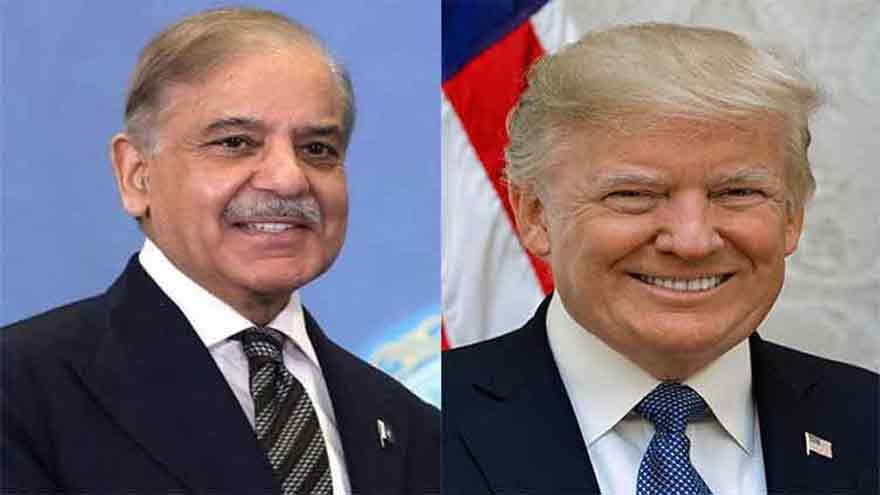
Prime Minister Shehbaz Sharif sent his appreciation to US President Donald Trump for his bold leadership and prompt declaration over the temporary suspension of Project Freedom in the Strait of Hormuz.
In a post on social media platform X, he stated: “President Trump’s benevolent response to the request from Pakistan and other allied nations, especially the Kingdom of Saudi Arabia and my esteemed brother Crown Prince and Prime Minister H.R.H. Prince Mohammed bin Salman, will significantly contribute to promoting regional peace, stability, and reconciliation during this critical juncture.”
He stated that Pakistan is steadfastly dedicated to endorsing any initiatives that foster restraint and a peaceful resolution of issues via dialogue and diplomacy.
“We are optimistic that the existing momentum will culminate in a sustainable agreement that ensures enduring peace and stability for the region and beyond,” stated the article.
On Tuesday, May 5, Trump announced the cessation of the US military operation to escort vessels through the Strait of Hormuz after only one day, aiming to negotiate a resolution with Iran to conclude the Middle East conflict.
Trump’s initiative, termed “Project Freedom”, commenced on Monday to assist vessels in departing the Strait of Hormuz, the constricted passage to the Gulf where Iran has asserted control following attacks.
The US leader announced on Truth Social that he is now suspending it at the request of mediator Pakistan and other nations, stating that “significant progress has been achieved toward a comprehensive and conclusive agreement” with Tehran.Trump stated, “We have reached a mutual agreement that, although the blockade will continue to be fully enforced, Project Freedom will be temporarily suspended to assess the possibility of finalising and signing the Agreement.”
Washington is enforcing a blockade on Iran’s ports to compel Iran to negotiate a resolution to the conflict initiated by the US and Israel on February 28.
Tensions escalated about the Hormuz operation, with the US claiming it had sunk seven Iranian warships, while many civilian ships reportedly faced attacks attributed to Iran.
Secretary of State Marco Rubio stated earlier on Tuesday that the confrontations in the Strait of Hormuz were not included in the initial conflict.Rubio stated, “This is not an offensive operation; it is a defensive operation.” “This means that shooting will only occur if we are fired upon first.”
He stated that the United States had concluded its offensive operations against Iran, designated as “Operation Epic Fury”.

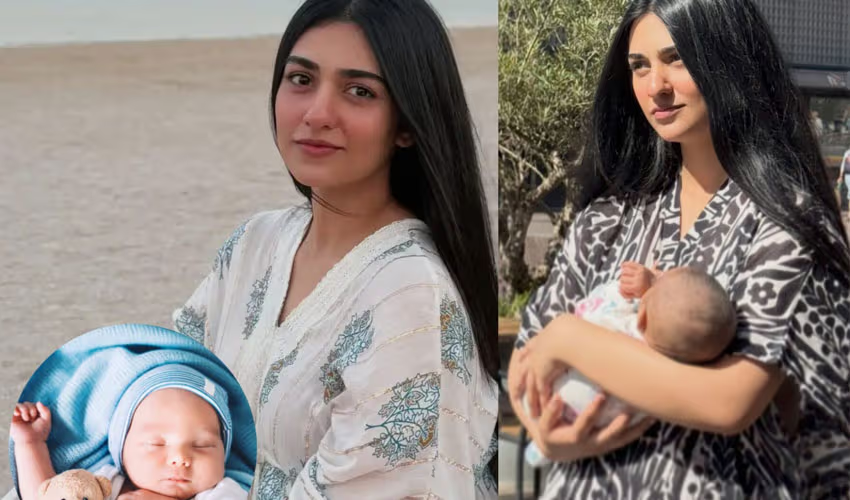
Pakistani actress Sarah Khan has addressed a question about whether she had hoped for a son during her second pregnancy, saying that she and her husband, singer Falak Shabir, only wished for a healthy child.
During a question-and-answer session on her Instagram account, a fan asked if she wanted a baby boy while expecting her second child.
Responding to the question, Sarah said, “We just wanted a child.”

The actress, who is the mother of two daughters, Alyana and Rania, also reflected on how motherhood has transformed her life.
When asked what she misses most about her life before marriage and children, Sarah replied that uninterrupted sleep is the only thing she misses after becoming a mother of two.
She also shared a light-hearted response when a follower asked whether she was watching the FIFA World Cup 2026.
“The only thing I’m watching these days is my daughters,” she joked.
Speaking about motherhood, Sarah described her daughters as the greatest blessing in her life.
“My life has become more beautiful. I am busier than ever. It’s the best time of my life, and I love my daughters. They are Allah’s greatest blessing upon me,” she said.
The actress added that her biggest goal as a mother is to raise kind and compassionate human beings and wished for all married women to be blessed with healthy children.
Sarah also revealed that she is “obsessed” with her husband, Falak Shabir, while joking that their daughters are even more attached to their father.
The actress recently earned praise for her performance in the drama Sher alongside Danish Taimoor and is set to appear in an upcoming Geo TV drama opposite Feroze Khan.
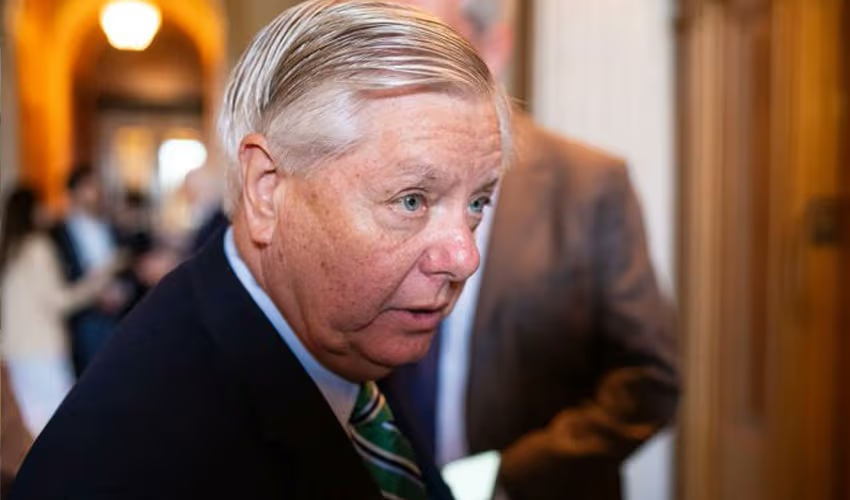
According to a statement sent by his office early on Sunday, Graham passed away on Saturday night.The statement read, “Senator Graham’s family requests privacy during this extremely trying time and appreciates prayers at this time.”
Among the first public figures to honor Graham was President Donald Trump, who described him as “one of the greatest people and Senators I have ever known.”
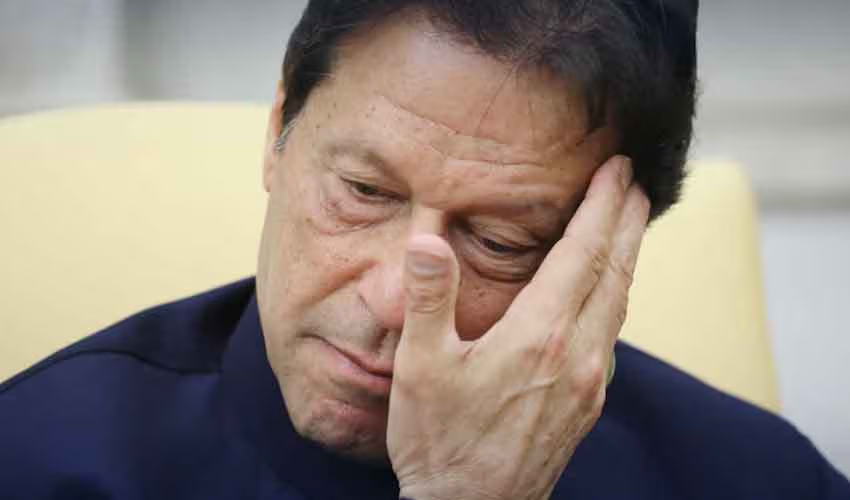
Imran Khan, the founder of Pakistan Tehreek-e-Insaf (PTI), had an eye exam at Rawalpindi’s Adiala jail.
Imran’s eye is thoroughly examined by medical professionals.
The inspection was conducted yesterday (Friday), according to information leaked on Saturday. Dr. Arif from PIMS and Dr. Nadeem Qureshi from Al-Shifa Trust were among the specialists who performed the examination.
Imran Khan’s eye was thoroughly examined by the physicians, according to sources.
Medication is prescribed by doctors as part of follow-up care.
Sources claim that as part of the follow-up treatment, the doctors recommended medication.

According to Sarah Khan, she never made a specific wish for a son.

US Senator Lindsey Graham passes away at age 71 following a brief illness

At Adiala jail, Imran Khan has his eyes examined.

ICC board meeting in India: Mohsin Naqvi gets invitation

The IMF mission has arrived in Pakistan for discussions regarding the budget.

Is the US-Iran standoff exposing deep fault lines in US intelligence coordination?
-
 Latest News2 months ago
ICC board meeting in India: Mohsin Naqvi gets invitation
-
 Business2 months ago
The IMF mission has arrived in Pakistan for discussions regarding the budget.
-
 Latest News1 month ago
Is the US-Iran standoff exposing deep fault lines in US intelligence coordination?
-

 Business2 months ago
Oil hits 2-week high following drone strike on UAE nuclear power facility
-
 Latest News1 month ago
Shehbaz, Zardari discuss key issues as PPP hints at budget support
-
 Latest News2 months ago
To commemorate the anniversary of Marka-e-Haq, top civic and military leaders assemble at Pakistan Monument.
-

 Latest News1 month ago
7.8 magnitude quake hits southern Philippines\
-
 Business2 months ago
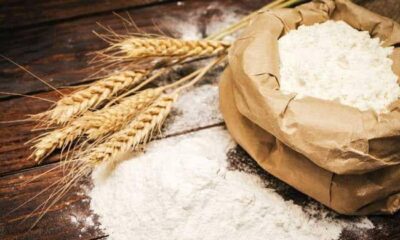
In the open market, flour prices increase by Rs 700 per mound.