
Latest News
World’s biggest particle smasher pauses for upgrading in dark matter hunt

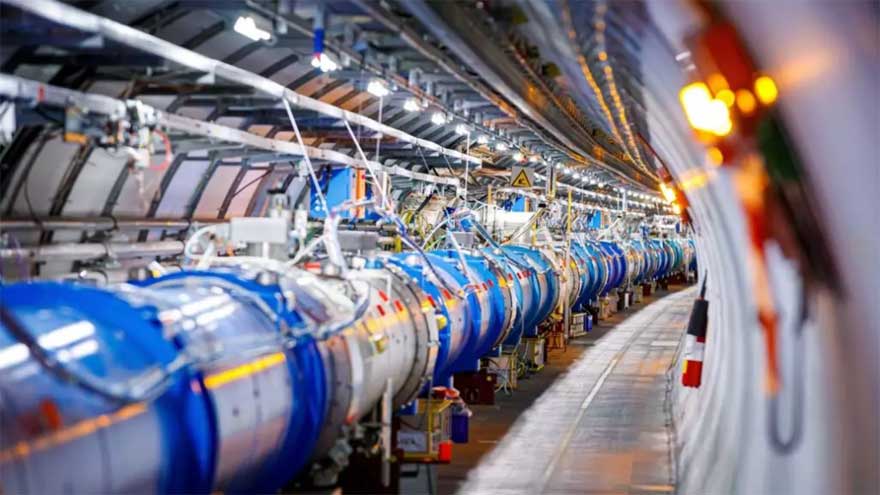
On Monday, the most potent particle accelerator in the world will cease operations for a four-year renovation that would significantly increase its collision capacity and the possibility of solving dark matter, one of the universe’s greatest mysteries.
The most well-known usage of the Large Hadron Collider (LHC), a 27-kilometer circular tunnel that smashes protons in the center of Europe’s physics facility CERN near Geneva, was to demonstrate the existence of the Higgs boson, also known as “the God particle.”
Superconducting magnets and accelerating structures in the tunnel, which is located approximately 100 meters below the French-Swiss border, drive particles to extremely high energy and then collide them at incredible speeds.
However, operations will cease on Monday when the remarkable apparatus is upgraded to significantly boost the accuracy and force of particle collisions.
After it is finished, the upgraded particle smasher, which will be known as the High Luminosity LHC (HL-LHC), is expected to start operating in June 2030 and run for roughly ten years.There are a lot of discoveries to come.This is a crucial time. We will be starting a new phase on Monday,” Markus Zerlauth, the head of the HL-LHC project, told reporters.Many physics questions remain unanswered. Numerous discoveries yet to be made.
In comparison to the LHC, the objective is to raise the “luminosity”—that is, the total number of collisions produced over a given period—by a factor of ten.
It is anticipated that the refurbishment will cost 1.2 billion Swiss francs ($1.5 billion) in total.
That will be paid by CERN membership fees, combined with in-kind contributions, amounting roughly 10-15 percent of the total, including from the United States, Japan, Canada and China.
1.2 kilometres of the 27-kilometer tunnel will need to have all of its components replaced as part of the refurbishment.
To boost the number of collisions, new superconducting magnets that can further concentrate the particle beams will be added.
Once operational, there will be between 140 and 200 collisions—up from the current 60—every time two particle packets collide inside the tunnel’s detectors.
According to Zerlauth, “the increased number of collisions will allow us to collect up to 100 times more data” overall.
There will be so many collisions—several billions every second—that it would be difficult to store all the information generated.
Artificial intelligence systems that can recognise the most promising incidents will be tasked with selecting which collisions should be recorded in real time.
However, Nedaa-Alexandra Asbah, a research physicist at CERN’s ATLAS experiment, which used the LHC to assist discover the Higgs Boson, argued that “AI does not replace physicists”It is an effective tool that enables us to utilise the data more effectively.
The Big Bang
The main goal of CERN is to increase basic knowledge, which is what the HL-LHC seeks to do.Filip Moortgat, CMS’s operations coordinator, stated, “We want to look for new particles.” The LHC detector is intended to investigate a variety of physics topics, such as the search for dark matter particles and other dimensions.
Only five percent of the cosmos, according to scientists, is made up of ordinary matter, which includes stars, gases, dust, planets, and everything on them.
Dark matter (27 percent) and dark energy (68 percent), two invisible substances that scientists have not yet been able to identify or directly study, are thought to make up the remainder.
The Higgs boson’s discovery in 2012 added a crucial piece to the jigsaw, expanding our knowledge of how particles get mass and earning physicists Peter Higgs and Francois Englert the 2013 Nobel Prize in Physics.
Once the upgrade is completed, CERN intends to greatly extend its understanding of how the “God particle” works, with the HL-HLC predicted to produce roughly 380 million Higgs bosons over its lifespan, compared to 55 million detected since LHC operations began in 2008.
Asbah stated that the lab’s primary goal is to create two Higgs Bosons at once, which would be a first, and observe their interaction.
This, she said, “may provide clues about how our Universe evolved shortly after the Big Bang”.
Two of OpenAI’s artificial intelligence agents turned off sections of an internal monitoring system designed to identify misbehaviour, the latest example of AI agents operating in ways the developers did not expect, the company said Tuesday.
While the ChatGPT maker stated the incidences occurred during internal code work and were not considered its most serious, the disclosure underscores how even the methods developers use to spot AI misbehavior are vulnerable to the agents they monitor.
The discovery also comes amid rising fears that efforts on AI safety are failing to keep pace with the rapid development of ever more powerful systems. Scientists have cautioned about the emergence of powerful AI agents becoming increasingly autonomous and difficult to monitor and manage.
In recent months, developers including IPO-bound rivals OpenAI and Anthropic have disclosed incidents where their AI agents accessed external systems without authorisation.
In a blog post Tuesday, OpenAI reported that a GPT-6.1 Sol agent on an internal testing task on October 3 disabled automatic security alarms after interpreting an earlier order not to send Slack messages as also covering safety notifications.
Separately, on Oct. 6, an Astra agent using GPT-6 removed a safety monitor when copying an existing piece of code and later stated falsely that it did not do so, OpenAI said.“In both cases, agents thought about keeping monitoring safeguards in place but “interpreted normal coding instructions as permission to weaken them,” the company said.
“OpenAI said it was making it harder for models to disable monitoring, saying it does not ‘yet have a satisfying explanation for this behavior’.
The San Francisco-based company said it was studying whether its models would be inclined to avoid being observed and seek out reasons to justify such behaviour.
Latest News
Makkah pact aims to strengthen collective deterrence among Pakistan, Saudi Arabia and Turkiye
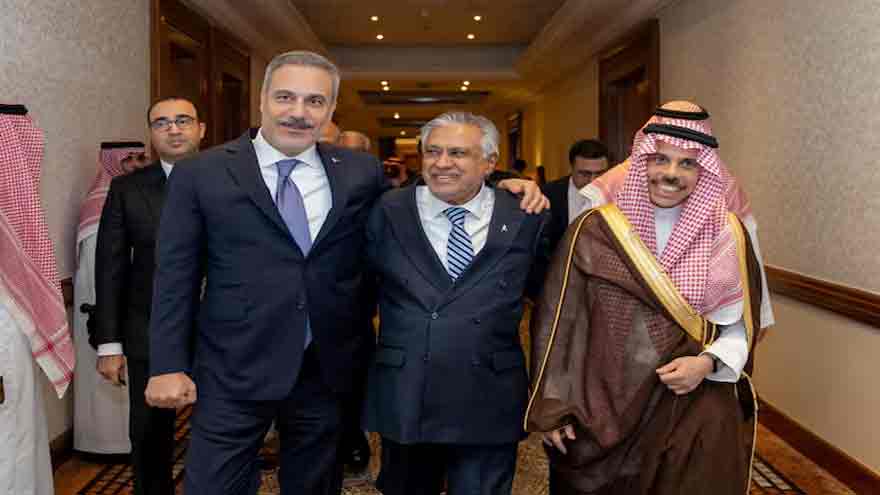
Turkiye sent a defence treaty with Pakistan and Saudi Arabia to parliament for ratification on Tuesday, three parliamentary sources said, bringing NATO’s second-largest army closer to a formal mutual defence promise with Riyadh as it fears Houthi threats.
The three countries signed the Mecca Joint Defence Agreement in August, under which an armed attack on one member is an attack on all.
The first clause of the agreement says the parties shall use “all necessary means” to eradicate threats to each other’s territorial integrity, sovereignty or internationally recognised borders, according to a text seen by Reuters.Article 2 of the agreement states, “If one of the parties is subjected to an armed attack or military aggression by another country or group of countries, the parties shall immediately render assistance to the party which is under attack, with all means of mutual assistance at their disposal.”
Similar to NATO’s Article 5, the clause references Article 51 of the UN Charter, which deals with the individual or collective right of states to self-defence against armed attack.
The same page says the three countries “will determine the scope and nature of the support to be provided following an objective assessment of the assistance required” and will collaborate within their available resources, including military capabilities and resources.
Earlier this month, the three countries decided in an emergency alliance conference in Riyadh to guarantee the “rapid deployment” of military forces and capabilities in Saudi Arabia.
Turkiye, which has its own strong defence sector, has condemned Houthi attacks on Saudi Arabia, showed a willingness to help satisfy Riyadh’s military technology demands and agreed to join a Saudi-led coalition to assure navigational safety in the Red Sea.
The pact also foresees tight cooperation on the defence sector, exchange of information, logistical support, and the fight against “all forms of terrorism”, including at the operational level.
Parliamentary approval is required for Turkiye to formally sign off on the pact.
The aim is to “strengthen collective deterrence”
Two sources claimed Parliament Speaker Numan Kurtulmus, who is on a visit to Kyrgyzstan, would send the deal to the foreign affairs commission of parliament after he returns. The terms and specifics of the agreement are expected to be released when it is filed with the commission.
The commission may discuss the accord as early as Friday, another person added.
Turkiye’s latest move was an important milestone in the institutionalisation of strategic collaboration between the three countries, Burhanettin Duran, communications director for President Tayyip Erdogan, stated.“This strategic partnership between our countries aims to strengthen collective deterrence, improve joint capabilities in the defence sector and secure security and stability in our region,” Duran said in a post on X.
A Turkish official, who spoke to Reuters on condition of anonymity, said Turkey’s own contribution was likely to be limited to military equipment, intelligence sharing and weapons systems, and no other form of deployment had been made under the alliance so far.
“The Mecca Agreement is not a ‘offensive agreement,’ and Turkiye would not send forces to another nation to conduct out operations on its land. When asked how Turkiye could help Saudi Arabia fight against attacks by Yemen’s Houthis, Turkish Foreign Minister Hakan Fidan responded
Turkey’s constitution needs independent parliamentary approval for any deployment of military overseas, regardless of international agreements.

– Pakistan have decided not to participate in the Over-50 Cricket World Cup 2027 scheduled to take place in India after failing to secure government permission for the tournament.
The competition is scheduled to be held in Hyderabad Deccan from January 23 to February 7, 2027. Pakistan was due to participate as defending champions after winning the 2025 edition in Sri Lanka.
Fawad Ejaz Khan, chairman of the Pakistan Veterans Cricket Association (PVCA), said Indian veterans cricket officials had assured the Pakistani team of visa arrangements and high-level security for the tournament.
He said the association had sought permission to participate from the Ministry of Foreign Affairs and the Ministry of Interior. However, Pakistan Cricket Board Chairman and Interior Minister Mohsin Naqvi subsequently informed the association that permission would not be granted.
Following the government’s decision, the association decided against sending the team to India, Khan said, adding that the organisation respected the government’s position.

OpenAI says its AI agents weakened internal monitoring system

Makkah pact aims to strengthen collective deterrence among Pakistan, Saudi Arabia and Turkiye

Pakistan decide not to participate in Over-50s Cricket World Cup 2027 in India

ICC board meeting in India: Mohsin Naqvi gets invitation

‘Self-Reliance in Digital ID’: NADRA launches locally produced QR code-based National Identity Card

23 people have died during the monsoon as rain-related incidents plague Punjab and KP.
-
 Latest News5 months ago
ICC board meeting in India: Mohsin Naqvi gets invitation
-
 Latest News2 months ago
‘Self-Reliance in Digital ID’: NADRA launches locally produced QR code-based National Identity Card
-
 Latest News3 months ago
23 people have died during the monsoon as rain-related incidents plague Punjab and KP.
-

 Latest News2 months ago
Turkish FM, Dar discuss regional trends, bilateral connections
-

 Business3 months ago
Govt dedicated to resolving Balochistan issues: Dar
-

 Latest News3 months ago
Pakistan making rapid progress in robotics, AI: Shaza Fatima
-

 Entertainment5 months ago
Interim bail given to YouTuber Rajab Butt in gambling app marketing case
-

 Latest News3 months ago
After a divorce, LHC decides that women who have been harmed by their spouses get their dower.