
Latest News
Pakistan requests that the UN Security Council fill in the framework’s inadequacies regarding counterterrorism.

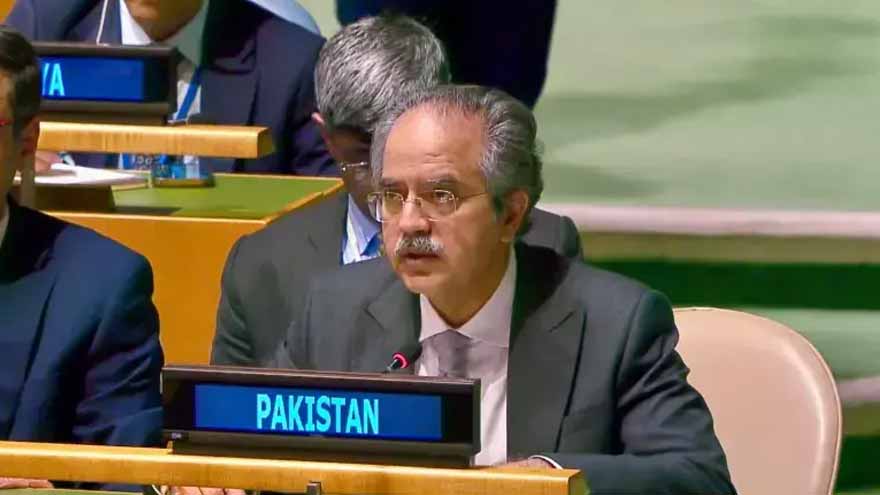
Pakistan has called for a stronger and forward-looking international response to terrorism, urging the United Nations Security Council to strengthen its counterterrorism framework and address shortcomings in the existing sanctions regime.
Speaking at a Security Council debate titled “Threats to International Peace and Security Caused by Terrorist Acts: 25 Years after 9/11 — Renewing the Security Council’s Fight Against Terrorism,” Pakistan’s Permanent Representative to the UN, Ambassador Asim Iftikhar Ahmad, paid tribute to the victims of the September 11 attacks, including seven Pakistanis, and expressed solidarity with the US government and people.
Recalling the international response to the 9/11 attacks, the ambassador said the Security Council had acted swiftly by adopting measures including Resolution 1373, which remains a key component of the UN’s counterterrorism framework.
Highlighting Pakistan’s role in the global fight against terrorism, Asim Iftikhar said the country’s counterterrorism operations, intelligence cooperation and security coordination with international partners had significantly weakened Al-Qaeda’s capabilities.
He said some of the most notable successes in the international campaign against Al-Qaeda had been achieved through Pakistan’s counterterrorism efforts and active cooperation.
The Pakistani envoy stressed that the country had paid a heavy price in the fight against terrorism. More than 90,000 Pakistanis, including security and law-enforcement personnel as well as civilians, have lost their lives in terrorist attacks since the beginning of the century, while the country has also suffered substantial economic losses.
He said that although the Security Council had responded to terrorism 25 years ago with urgency, unity and determination, the nature of the threat had since changed considerably, with new forms of extremism and emerging challenges requiring a revised international response.
Asim Iftikhar called for improvements to the existing sanctions mechanisms to close loopholes in the international counterterrorism system.
He drew attention to the rise of far-right extremism, persistent terrorist threats in Africa, the Middle East and Afghanistan, and the growing use of modern technology by terrorist groups for propaganda, radicalisation, recruitment, communication and financing.
Expressing particular concern over terrorism emanating from Afghanistan, he said more than 4,700 Pakistanis had been killed in terrorist attacks over the past three years.
He urged the international community to take effective action against terrorist organisations including the Tehreek-e-Taliban Pakistan (TTP), Balochistan Liberation Army (BLA), East Turkestan Islamic Movement (ETIM) and Daesh.
The ambassador also warned about the increasing use of the dark web, virtual assets and cryptocurrencies to finance terrorism. He cautioned that the threat could grow substantially in the absence of effective regulatory mechanisms.
Calling for a comprehensive approach to counterterrorism, he stressed the need for balanced implementation of all four pillars of the UN Global Counter-Terrorism Strategy, along with greater attention to the root causes of terrorism and conditions that allow extremist groups to flourish.
He also called for accountability in situations involving foreign occupation, arguing that occupying powers should be held accountable and should not be allowed to act with impunity against people exercising their right to self-determination.
Asim Iftikhar said the international community must ensure that its response keeps pace with — and stays ahead of — the rapidly evolving terrorist threat.
He urged the Security Council to fulfil its responsibilities, ensure that perpetrators are brought to justice, and strengthen international cooperation and regional coordination to build a united and collective front against terrorism.
Latest News
A Chinese newspaper claims that Pakistan has won diplomatically with the Indus Waters Treaty.
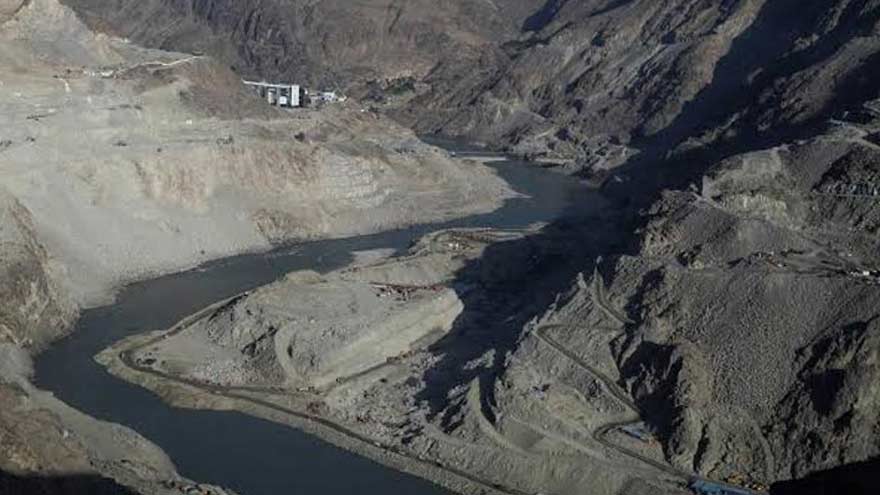
China’s leading newspaper South China Morning Post has described an international tribunal’s ruling on the Indus Waters Treaty as a significant success for Pakistan.
According to the Chinese publication, the tribunal’s decision came as an unexpected setback for India and a major boost for Pakistan’s position on the long-running water dispute.
The newspaper noted that despite wars and prolonged tensions between Pakistan and India, the Indus Waters Treaty had remained in place for decades.
It reported that the Permanent Court of Arbitration ruled on August 31 that New Delhi had no legal basis to suspend the treaty. The tribunal also ordered restrictions on aspects of the construction of the Ratle Hydroelectric Power Project in Indian-occupied Kashmir.
The South China Morning Post said the ruling further strengthened Pakistan’s stance, with the five-member tribunal unanimously rejecting India’s arguments concerning the suspension of the treaty.
The Chinese newspaper described the ruling as a clear decision in Pakistan’s favour over India’s disputed move, calling it a diplomatic achievement for Islamabad.
It added that the tribunal’s decision had effectively challenged India’s position and strengthened Pakistan’s case in the dispute over the implementation of the Indus Waters Treaty.

A settlement panel rejected Chinese investor Min Fengzhen’s challenge of a 2024 claim dismissal, giving South Korea a final decision in a 264 billion won ($197 million) investor-state dispute, according to the justice ministry on Sunday.
According to a statement from the ministry, this is South Korea’s first win in a complete hearing of an international investor dispute.
The case focused on Min’s allegation that a lender’s seizure and sale of pledged shares connected to a failing Beijing real estate project violated protections under an investment treaty between South Korea and China.
In 2024, the initial tribunal rejected the claim, stating that the investment was unlawful and hence not covered by the treaty.

Pakistan suffered another major setback in Test cricket after being whitewashed by England in the Test series, dropping one place to ninth in the 10-team rankings.
The whitewash against England has further deepened Pakistan’s struggles in Test cricket, with the national team reaching its lowest-ever position in the 10-team Test rankings.
Pakistan have won only seven of their last 20 Test matches, while their continued poor performances have also resulted in a decline in the rankings.
The national team have suffered whitewashes in six of their last 12 Test series, further highlighting Pakistan’s struggles to maintain their position in Test cricket.
The latest rankings setback comes after Pakistan failed to avoid a series whitewash against England, adding to concerns over the team’s continued poor run in the longest format.

A Chinese newspaper claims that Pakistan has won diplomatically with the Indus Waters Treaty.

South Korea prevails over a Chinese investor in an investment treaty issue.

Pakistan slips to ninth in test rankings after England whitewash

ICC board meeting in India: Mohsin Naqvi gets invitation

23 people have died during the monsoon as rain-related incidents plague Punjab and KP.

Govt dedicated to resolving Balochistan issues: Dar
-
 Latest News4 months ago
ICC board meeting in India: Mohsin Naqvi gets invitation
-
 Latest News2 months ago
23 people have died during the monsoon as rain-related incidents plague Punjab and KP.
-
 Business2 months ago
Govt dedicated to resolving Balochistan issues: Dar
-

 Latest News2 months ago
Pakistan making rapid progress in robotics, AI: Shaza Fatima
-

 Latest News4 weeks ago
‘Self-Reliance in Digital ID’: NADRA launches locally produced QR code-based National Identity Card
-

 Latest News2 months ago
After a divorce, LHC decides that women who have been harmed by their spouses get their dower.
-

 Latest News4 months ago
A meta program to monitor mouse clicks made by employees in violation of EU privacy regulations
-

 Entertainment4 months ago
Interim bail given to YouTuber Rajab Butt in gambling app marketing case