
Latest News
Israeli Strikes Pound South, East Lebanon Deadly

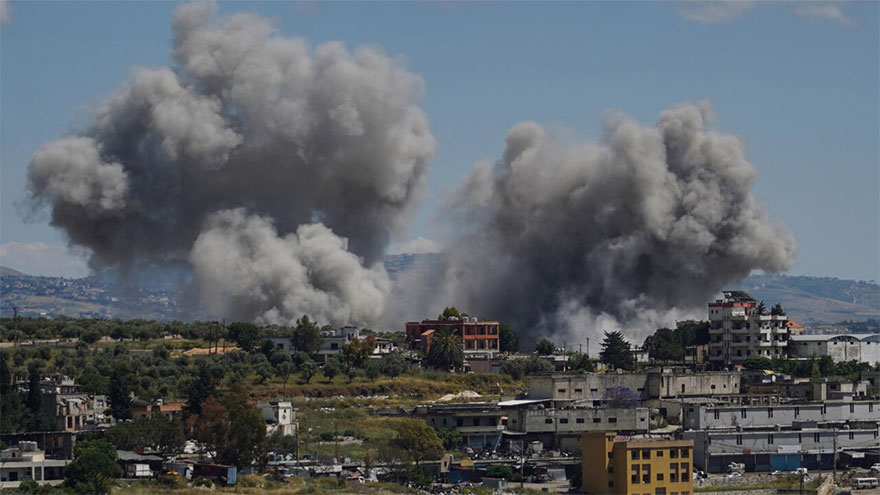
Israeli strikes blasted south and east Lebanon Sunday despite a ceasefire as Hezbollah’s head expressed hope for a deal between Iran and the United States to end the Middle East war that includes Lebanon.
The Lebanese health ministry put the overall death toll in the battle since March 2 at 3,123.
Two persons, including a paramedic from the Hezbollah-affiliated Islamic Health Committee, were murdered Sunday in Israeli raids, it said.
The ministry said Sunday it condemned a “massacre” after 11 people including six women and a child were murdered in a single hit in Sir al-Gharbiyeh in the south a day earlier.
Despite a ceasefire in Lebanon that began on April 17 and was recently extended for several weeks, Israel’s military has continued to strike what it says are Hezbollah targets in Lebanon.
The Iran-backed Hezbollah has also continued attacking Israeli troops who have invaded southern Lebanon and targets across the border, claiming more than 20 such attacks on Sunday including with rockets, attack drones and artillery.
Iran has said that an agreement with Washington to end the regional war would also apply to Lebanon, but Israeli Prime Minister Benjamin Netanyahu said US President Donald Trump had reiterated his backing for Israel’s right “to defend itself against threats on all fronts, including in Lebanon”.
The Israeli military leader Lieutenant General Eyal Zamir declared that “we continue to strike Hezbollah across all dimensions… the security of civilians and the safety of our forces remain paramount”, a statement added.
Lebanon’s official National News Agency said that Israeli warplanes attacked more than 30 sites in south and east Lebanon on Sunday, with some of the strikes causing deaths.
After strikes in numerous spots, AFP correspondents saw enormous plumes of smoke.
The Israeli military also gave evacuation advisories for more than a dozen villages in southern Lebanon and the eastern Bekaa valley.
Lebanon’s civil defence service reported an overnight Israeli strike destroyed its regional centre in Nabatieh.
AFP photographer observed civil defence workers retrieving equipment from the ruins.
The Israeli military had no comment on the strike when contacted by AFP’s Jerusalem office.DON’T KNIFE US IN THE BACK’
Hezbollah chairman Naim Qassem said that “God willing, this agreement (between the US and Iran) will be finalised… and accordingly that we too will be among those included in this agreement” on a complete halt to hostilities.
Again he said his side rejected direct discussions between Israel and Lebanon.
Lebanese authorities have recently started significant direct discussions with Israel under US auspices and are planning for a fourth round in early June, preceded by a meeting with military teams at the Pentagon on May 29.Shun the direct negotiations… “Don’t be with them and stab us in the back,” Qassem urged.
He also claimed that “disarmament is annihilation and we cannot accept it”, adding that “we and our people face an existential threat”.Even if the whole world turns against us we will not bow down.
After Qassem’s address, US Secretary of State Marco Rubio accused Hezbollah of wanting to pull Lebanon “back into chaos”.
Hezbollah pulled Lebanon into the Middle East war on March 2, firing rockets at Israel to retaliate for the execution of Iran’s supreme commander in US-Israeli bombings.
According to the truce declared by Washington, Israel has the right to respond to “planned, imminent or ongoing attacks”.
Israeli troops that invaded Lebanon are also operating inside an Israeli-declared “yellow line” that runs around 10 kilometres (six miles) inside Lebanon from its southern border.
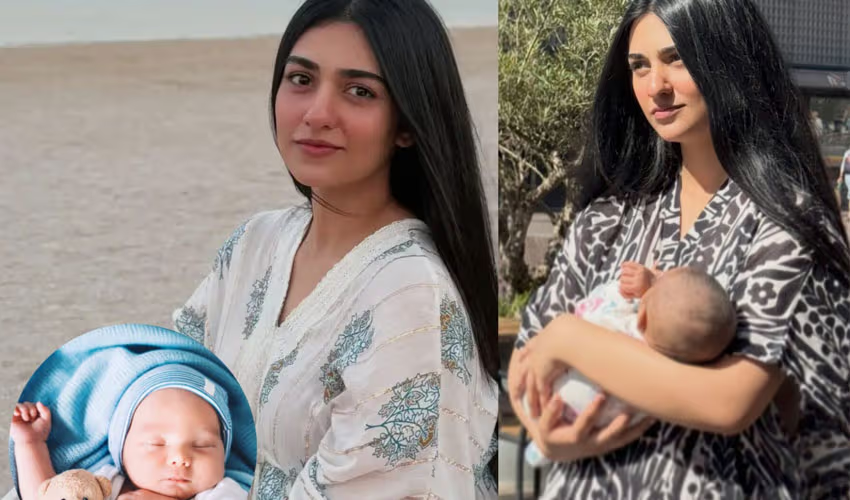
Pakistani actress Sarah Khan has addressed a question about whether she had hoped for a son during her second pregnancy, saying that she and her husband, singer Falak Shabir, only wished for a healthy child.
During a question-and-answer session on her Instagram account, a fan asked if she wanted a baby boy while expecting her second child.
Responding to the question, Sarah said, “We just wanted a child.”

The actress, who is the mother of two daughters, Alyana and Rania, also reflected on how motherhood has transformed her life.
When asked what she misses most about her life before marriage and children, Sarah replied that uninterrupted sleep is the only thing she misses after becoming a mother of two.
She also shared a light-hearted response when a follower asked whether she was watching the FIFA World Cup 2026.
“The only thing I’m watching these days is my daughters,” she joked.
Speaking about motherhood, Sarah described her daughters as the greatest blessing in her life.
“My life has become more beautiful. I am busier than ever. It’s the best time of my life, and I love my daughters. They are Allah’s greatest blessing upon me,” she said.
The actress added that her biggest goal as a mother is to raise kind and compassionate human beings and wished for all married women to be blessed with healthy children.
Sarah also revealed that she is “obsessed” with her husband, Falak Shabir, while joking that their daughters are even more attached to their father.
The actress recently earned praise for her performance in the drama Sher alongside Danish Taimoor and is set to appear in an upcoming Geo TV drama opposite Feroze Khan.
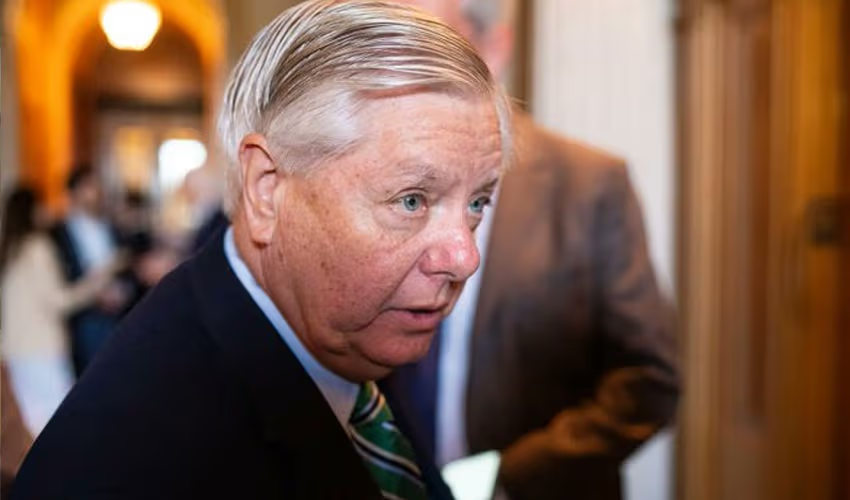
According to a statement sent by his office early on Sunday, Graham passed away on Saturday night.The statement read, “Senator Graham’s family requests privacy during this extremely trying time and appreciates prayers at this time.”
Among the first public figures to honor Graham was President Donald Trump, who described him as “one of the greatest people and Senators I have ever known.”
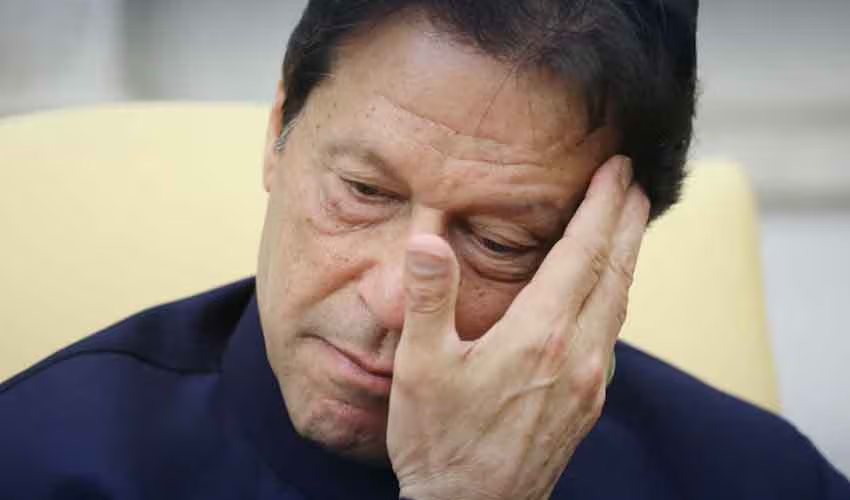
Imran Khan, the founder of Pakistan Tehreek-e-Insaf (PTI), had an eye exam at Rawalpindi’s Adiala jail.
Imran’s eye is thoroughly examined by medical professionals.
The inspection was conducted yesterday (Friday), according to information leaked on Saturday. Dr. Arif from PIMS and Dr. Nadeem Qureshi from Al-Shifa Trust were among the specialists who performed the examination.
Imran Khan’s eye was thoroughly examined by the physicians, according to sources.
Medication is prescribed by doctors as part of follow-up care.
Sources claim that as part of the follow-up treatment, the doctors recommended medication.

According to Sarah Khan, she never made a specific wish for a son.

US Senator Lindsey Graham passes away at age 71 following a brief illness

At Adiala jail, Imran Khan has his eyes examined.

ICC board meeting in India: Mohsin Naqvi gets invitation

The IMF mission has arrived in Pakistan for discussions regarding the budget.

Is the US-Iran standoff exposing deep fault lines in US intelligence coordination?
-
 Latest News2 months ago
ICC board meeting in India: Mohsin Naqvi gets invitation
-
 Business2 months ago
The IMF mission has arrived in Pakistan for discussions regarding the budget.
-
 Latest News1 month ago
Is the US-Iran standoff exposing deep fault lines in US intelligence coordination?
-

 Business2 months ago
Oil hits 2-week high following drone strike on UAE nuclear power facility
-
 Latest News1 month ago
Shehbaz, Zardari discuss key issues as PPP hints at budget support
-
 Latest News2 months ago
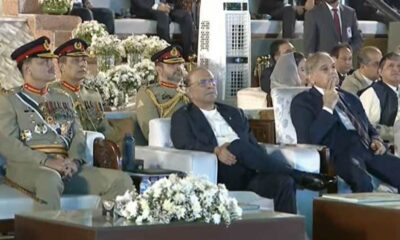
To commemorate the anniversary of Marka-e-Haq, top civic and military leaders assemble at Pakistan Monument.
-

 Latest News1 month ago
7.8 magnitude quake hits southern Philippines\
-

 Business2 months ago
In the open market, flour prices increase by Rs 700 per mound.