
Latest News
According to President Zardari, Marka-e-Haq is a pivotal period in Pakistani history.

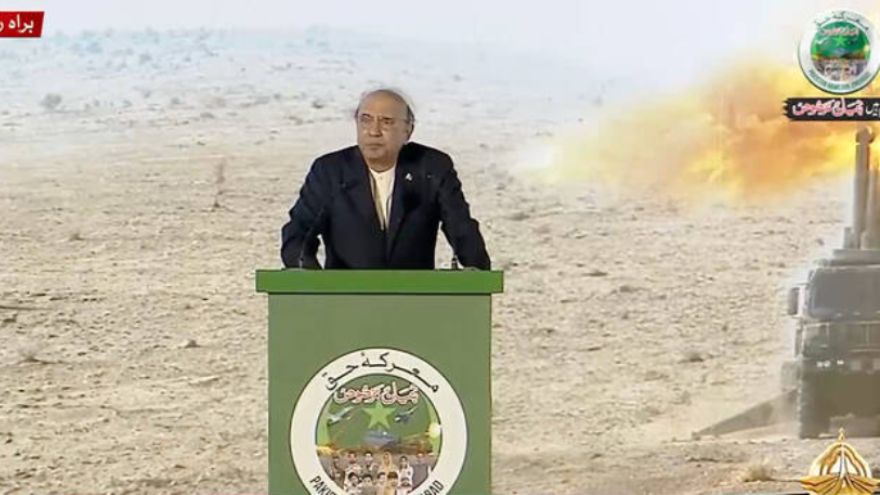
“Marka-e-Haq” was one of the most important periods in Pakistan’s history, according to President Asif Ali Zardari, who stated on Sunday that the nation had responded to Indian aggression with a “calibrated and shocking response” while acting responsibly.
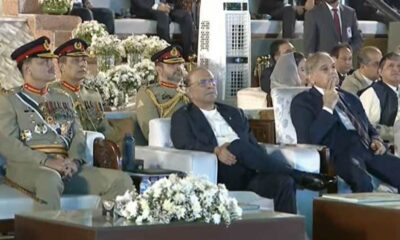
The president was speaking at a special event at the Pakistan Monument in Islamabad to commemorate the first anniversary of the conflict, which started with the attack on Pahalgam on April 22 and ended on May 10 of last year with a truce following Operation Bunyan-un-Marsoos.
Along with senior civil and military officials, foreign diplomats, and political figures, the ceremony was attended by Prime Minister Shehbaz Sharif, Chief of Defence Forces and Chief of Army Staff Field Marshal Syed Asim Munir, Chief of Naval Staff Admiral Naveed Ashraf, and Chief of Air Staff Air Chief Marshal Zaheer Ahmad Baber Sidhu.
In his remarks, President Zardari accused India of using the false flag Pahalgam event as justification for unjustified aggression.
He criticized Indian media for propagating false narratives during the crisis and declared, “India launched airstrikes on Pakistan’s civilian and worship places without any justification.”
According to the president, Field Marshal Asim Munir’s “dynamic leadership” enabled Pakistan’s military forces to react successfully.
“Pakistan responded to the Indian aggression with a calculated and startling response,” he stated.
Despite Pakistan’s military might, President Zardari insisted that the country acted with maturity and moderation.
“As a responsible and peace-preferring state, our response was mature and measured,” he said.
The president praised the Pakistan Air Force, saying that despite confronting a more powerful opponent, its pilots had shown remarkable competence and confidence during the conflict.
“Our pilots defended our skies with extraordinary skills and confidence, despite facing a larger adversary,” he stated.

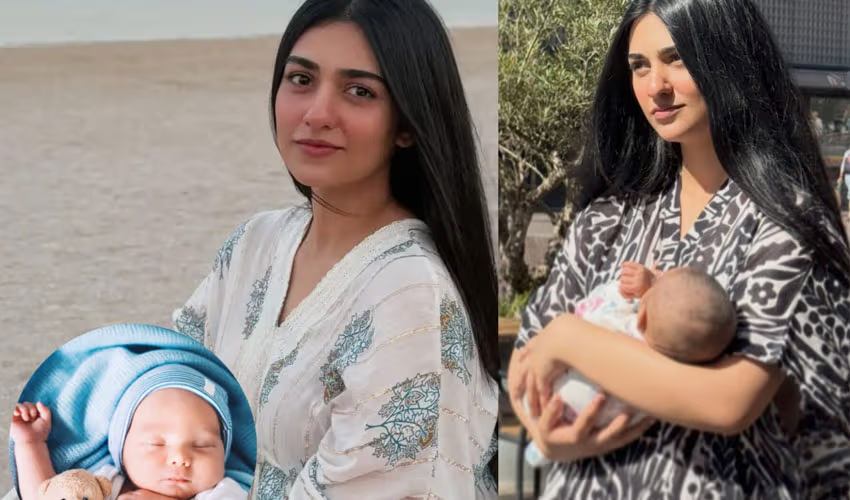
Pakistani actress Sarah Khan has addressed a question about whether she had hoped for a son during her second pregnancy, saying that she and her husband, singer Falak Shabir, only wished for a healthy child.
During a question-and-answer session on her Instagram account, a fan asked if she wanted a baby boy while expecting her second child.
Responding to the question, Sarah said, “We just wanted a child.”

The actress, who is the mother of two daughters, Alyana and Rania, also reflected on how motherhood has transformed her life.
When asked what she misses most about her life before marriage and children, Sarah replied that uninterrupted sleep is the only thing she misses after becoming a mother of two.
She also shared a light-hearted response when a follower asked whether she was watching the FIFA World Cup 2026.
“The only thing I’m watching these days is my daughters,” she joked.
Speaking about motherhood, Sarah described her daughters as the greatest blessing in her life.
“My life has become more beautiful. I am busier than ever. It’s the best time of my life, and I love my daughters. They are Allah’s greatest blessing upon me,” she said.
The actress added that her biggest goal as a mother is to raise kind and compassionate human beings and wished for all married women to be blessed with healthy children.
Sarah also revealed that she is “obsessed” with her husband, Falak Shabir, while joking that their daughters are even more attached to their father.
The actress recently earned praise for her performance in the drama Sher alongside Danish Taimoor and is set to appear in an upcoming Geo TV drama opposite Feroze Khan.
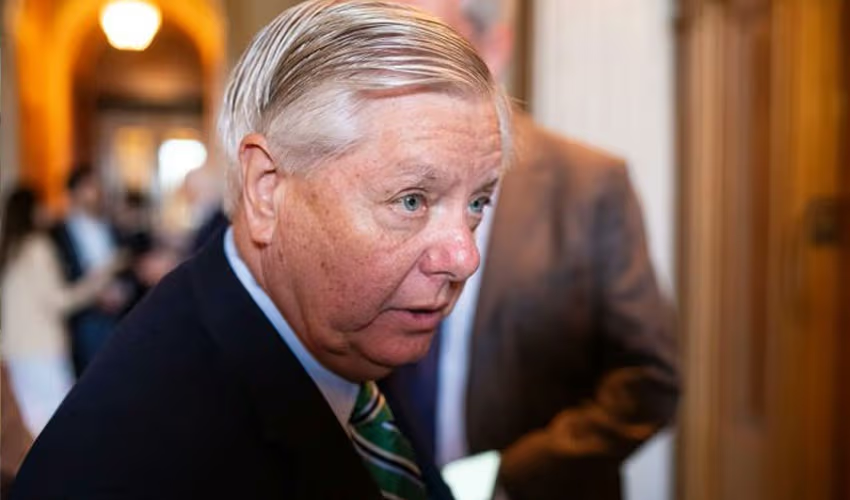
According to a statement sent by his office early on Sunday, Graham passed away on Saturday night.The statement read, “Senator Graham’s family requests privacy during this extremely trying time and appreciates prayers at this time.”
Among the first public figures to honor Graham was President Donald Trump, who described him as “one of the greatest people and Senators I have ever known.”
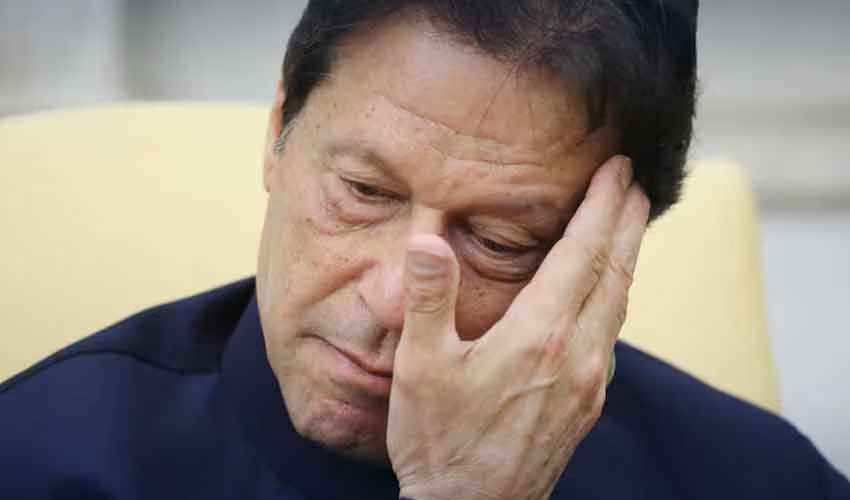
Imran Khan, the founder of Pakistan Tehreek-e-Insaf (PTI), had an eye exam at Rawalpindi’s Adiala jail.
Imran’s eye is thoroughly examined by medical professionals.
The inspection was conducted yesterday (Friday), according to information leaked on Saturday. Dr. Arif from PIMS and Dr. Nadeem Qureshi from Al-Shifa Trust were among the specialists who performed the examination.
Imran Khan’s eye was thoroughly examined by the physicians, according to sources.
Medication is prescribed by doctors as part of follow-up care.
Sources claim that as part of the follow-up treatment, the doctors recommended medication.

According to Sarah Khan, she never made a specific wish for a son.

US Senator Lindsey Graham passes away at age 71 following a brief illness

At Adiala jail, Imran Khan has his eyes examined.

ICC board meeting in India: Mohsin Naqvi gets invitation

The IMF mission has arrived in Pakistan for discussions regarding the budget.

Is the US-Iran standoff exposing deep fault lines in US intelligence coordination?
-
 Latest News2 months ago
ICC board meeting in India: Mohsin Naqvi gets invitation
-
 Business2 months ago
The IMF mission has arrived in Pakistan for discussions regarding the budget.
-
 Latest News1 month ago
Is the US-Iran standoff exposing deep fault lines in US intelligence coordination?
-

 Business2 months ago
Oil hits 2-week high following drone strike on UAE nuclear power facility
-
 Latest News1 month ago
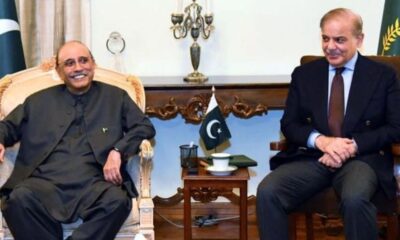
Shehbaz, Zardari discuss key issues as PPP hints at budget support
-
 Latest News2 months ago
To commemorate the anniversary of Marka-e-Haq, top civic and military leaders assemble at Pakistan Monument.
-

 Latest News1 month ago
7.8 magnitude quake hits southern Philippines\
-

 Business2 months ago
In the open market, flour prices increase by Rs 700 per mound.