
Latest News
FIFA World Cup to create wealth and CO2 unprecedented


Environmental scientists claim that the biggest and most lucrative World Cup ever this summer will also be the most polluted athletic event in history.
“Unlike the case of the Olympic Games, where the carbon footprints have been reducing over the last several editions, this is totally opposite in the case of FIFA men’s World Cup,” David Gogishvili, a geographer at the University of Lausanne (Unil), told AFP.
The summer’s World Cup is bigger than ever, with 48 teams for the first time. It will also for the first time be played in three countries – Mexico, Canada and the United States.
It will generate revenues on an unprecedented scale, but Unil’s research reveals it will “produce the largest carbon footprint in the history of international sport”.
Gogishvili continued: “Unil has calculated that emissions generated by CO2 will be between five and nine million tonnes, compared to “some 1.75 million tonnes” for the Paris Olympics in 2024.
That figure dwarfs the estimated 2.17m tonnes of CO2 produced by Russia in 2018, in a far-flung World Cup that included 40 fewer matches, and the 3.17m tonnes from Qatar in 2022, in a highly compact event condemned for its quickly built, oversized and air-conditioned stadiums.
All 16 venues for this summer, from the “smallest” in Toronto with 45,000 seats to the largest in Arlington, Texas, which has 94,000 seats, were already in place when the Games were given, a point made clear in 2018 by the “United 2026” bid.
The biggest problem is the great distance between stadiums.
Miami and Vancouver are over 4,500 km apart.
That will raise the main source of CO2 emissions for international events: plane travel for teams, officials, media and especially the “more than five million fans” targeted by FIFA.
At least Bosnia-Herzegovina will travel 5,040 km to play group games in Toronto, Los Angeles and eventually Seattle.
‘FIFA’s environmental denial
FIFA president Gianni Infantino, who declared his “determination” to tackle climate change at COP26 in Glasgow, has vowed to “measure, reduce and offset” emissions linked to its World Cups.
FIFA, however, has shied away from making any promises for 2026, after being admonished in June 2023 by the Swiss Fairness Commission (CSL) for false promotion of the “climate neutrality” of the 2022 World Cup.
A strategy to lessen the impact of mega-competitions is to cut their size, said Gogishvili, who was trained as an environmental analyst. The International Olympic Committee has set a quota of 10,500 athletes for the Summer Games.
FIFA, a year after boosting its World Club Cup from seven to 32 teams, is doing the exact opposite by increasing its flagship tournament from 32 to 48 teams.
The climate cost of each international match, is “26 to 42 times greater than an elite match” at the country level, stated a 2025 analysis published by New Weather Institute think-tank.
“A single match in the final stages of the men’s World Cup is responsible for 44,000 to 72,000 tonnes of CO2,” the report’s authors from the British-based Scientists for Global Responsibility claimed.
That, they concluded, was the equivalent of the emissions of 31,500 to 51,500 British cars over a whole year.
“It’s a never-ending cycle of more athletes, more fans, more hotel infrastructure, more flights, because of FIFA’s insatiable appetite for growth,” Gogishvili added.
The 2030 World Cup will be played across three continents and six countries. It begins with three matches in Argentina, Uruguay and Paraguay before the competition heads to hosts Morocco, Spain and Portugal for the remaining 101 matches.
The 2034 World Cup will be in Saudi Arabia, a Qatar-like environment but 40 more games in a far bigger country. Saudi Aramco, the world’s largest oil business, became a key FIFA sponsor in 2024.
“It looks like FIFA’s environmental denial will go on,” said Gilles Pache, professor at Aix-Marseille University, in the Journal of Management Research in 2024.

Pakistani actress Sarah Khan has addressed a question about whether she had hoped for a son during her second pregnancy, saying that she and her husband, singer Falak Shabir, only wished for a healthy child.
During a question-and-answer session on her Instagram account, a fan asked if she wanted a baby boy while expecting her second child.
Responding to the question, Sarah said, “We just wanted a child.”

The actress, who is the mother of two daughters, Alyana and Rania, also reflected on how motherhood has transformed her life.
When asked what she misses most about her life before marriage and children, Sarah replied that uninterrupted sleep is the only thing she misses after becoming a mother of two.
She also shared a light-hearted response when a follower asked whether she was watching the FIFA World Cup 2026.
“The only thing I’m watching these days is my daughters,” she joked.
Speaking about motherhood, Sarah described her daughters as the greatest blessing in her life.
“My life has become more beautiful. I am busier than ever. It’s the best time of my life, and I love my daughters. They are Allah’s greatest blessing upon me,” she said.
The actress added that her biggest goal as a mother is to raise kind and compassionate human beings and wished for all married women to be blessed with healthy children.
Sarah also revealed that she is “obsessed” with her husband, Falak Shabir, while joking that their daughters are even more attached to their father.
The actress recently earned praise for her performance in the drama Sher alongside Danish Taimoor and is set to appear in an upcoming Geo TV drama opposite Feroze Khan.
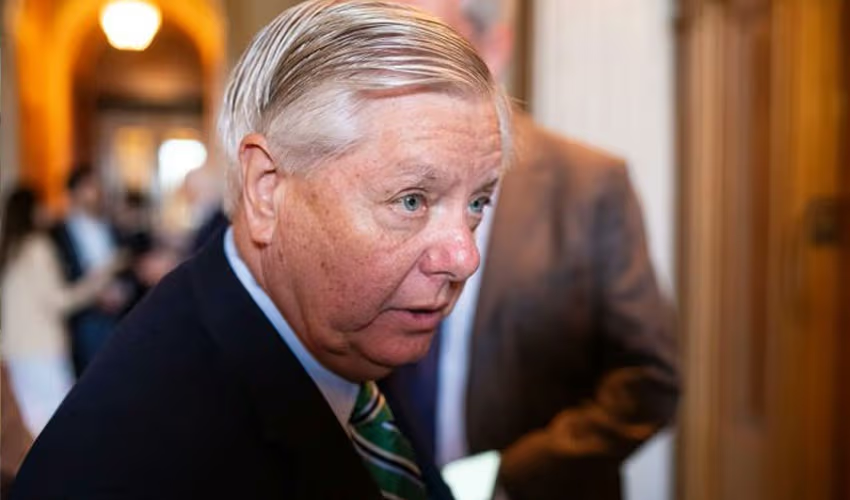
According to a statement sent by his office early on Sunday, Graham passed away on Saturday night.The statement read, “Senator Graham’s family requests privacy during this extremely trying time and appreciates prayers at this time.”
Among the first public figures to honor Graham was President Donald Trump, who described him as “one of the greatest people and Senators I have ever known.”
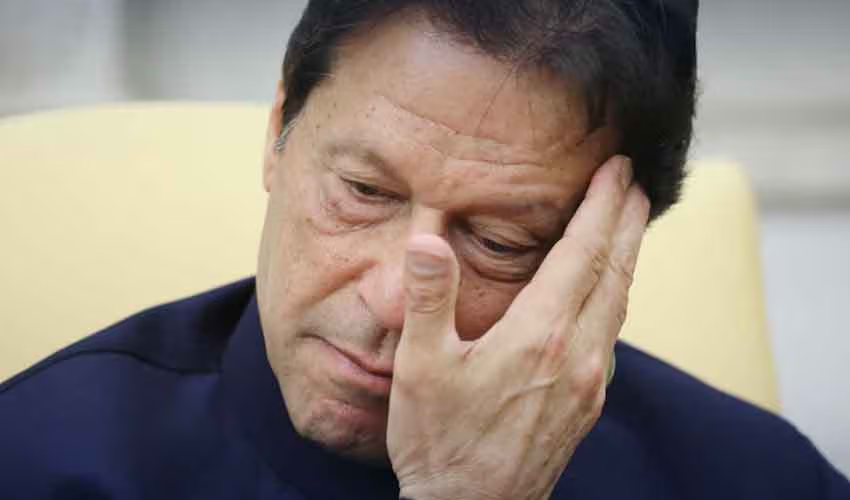
Imran Khan, the founder of Pakistan Tehreek-e-Insaf (PTI), had an eye exam at Rawalpindi’s Adiala jail.
Imran’s eye is thoroughly examined by medical professionals.
The inspection was conducted yesterday (Friday), according to information leaked on Saturday. Dr. Arif from PIMS and Dr. Nadeem Qureshi from Al-Shifa Trust were among the specialists who performed the examination.
Imran Khan’s eye was thoroughly examined by the physicians, according to sources.
Medication is prescribed by doctors as part of follow-up care.
Sources claim that as part of the follow-up treatment, the doctors recommended medication.

According to Sarah Khan, she never made a specific wish for a son.

US Senator Lindsey Graham passes away at age 71 following a brief illness

At Adiala jail, Imran Khan has his eyes examined.

ICC board meeting in India: Mohsin Naqvi gets invitation

The IMF mission has arrived in Pakistan for discussions regarding the budget.

Is the US-Iran standoff exposing deep fault lines in US intelligence coordination?
-
 Latest News2 months ago
ICC board meeting in India: Mohsin Naqvi gets invitation
-
 Business2 months ago
The IMF mission has arrived in Pakistan for discussions regarding the budget.
-
 Latest News1 month ago
Is the US-Iran standoff exposing deep fault lines in US intelligence coordination?
-

 Business2 months ago
Oil hits 2-week high following drone strike on UAE nuclear power facility
-
 Latest News1 month ago
Shehbaz, Zardari discuss key issues as PPP hints at budget support
-

 Latest News2 months ago
To commemorate the anniversary of Marka-e-Haq, top civic and military leaders assemble at Pakistan Monument.
-

 Latest News1 month ago
7.8 magnitude quake hits southern Philippines\
-

 Business2 months ago
In the open market, flour prices increase by Rs 700 per mound.