
Business
Minister: No forced land acquisition in telecom bill

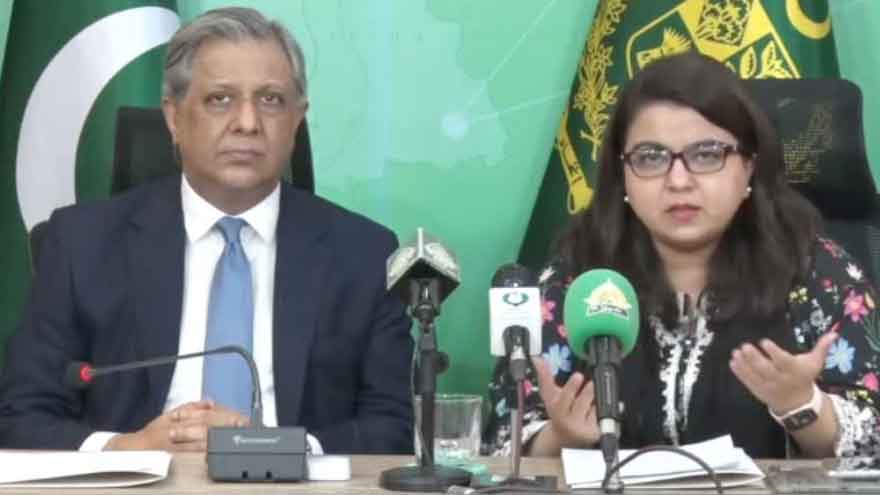
Federal Minister for Information Technology, Shaza Fatima, underlined that the proposed Telecom Bill will not allow forceful occupancy of private land or property of any person and said that appropriate categories for private properties will be defined.
Shaza Fatima, along with Federal Law Minister Azam Nazeer Tarar, rejected the allegations of financial irregularities and other allegations in respect of Telecom Bill as unfounded in a news conference here. She said the prime minister has been asked to direct an investigation into the allegations leveled against the legislation.
The IT minister said that the main aim of the new Telecom Bill is to provide high-speed internet across the country and the legislation is being built through consensus.
On the occasion Law Minister Azam Nazeer Tarar indicated that consent of the property owner will be mandatory before building fiber-optic infrastructure on private land. He said the Telecommunications Act Bill had been passed with six revisions.
Tarar also stated the parliamentary committee did not find any indication that the law was designed to favor any particular firm and had directed all faults in the draft legislation to be remedied.

The United Arab Emirates (UAE) has suspended all trade activities, exchanges and financial transactions with Iran until further notice, the foreign ministry said in a statement on Wednesday, citing regional escalation that it said undermined regional and international peace and security.
The announcement came after the UAE’s defence ministry said on Tuesday that it had detected two ballistic missiles launched from Iran, the first such incident reported since a May 4 strike on the Fujairah port.
In a statement later, the ministry said the missiles targeted “maritime traffic” based on its assessments. Both missiles fell into the sea, it said.
Iran’s foreign ministry spokesperson Esmaeil Baghaei rejected early on Wednesday the statement by the UAE, describing it as “baseless.”
Baghaei called on “all regional parties” to refrain from making “unsubstantiated accusations” against Iran, according to Al Jazeera.
The spokesperson said that any assessment of the situation must account for what he called the continued “malicious actions” of the US and Israel against regional peace and security, pointing to what he described as a history of false-flag operations in the region.
The missile launch comes as a 60-day window for US-Iranian peace talks expired on Monday without a breakthrough, raising fears of a new escalation in the conflict that has disrupted shipping through the Strait of Hormuz since February.
“The defence ministry affirms its full readiness to deal with any threats and firmly confront anything that aims to destabilise the state’s security,” it said in a statement.
The UAE’s interior ministry sent a phone alert earlier on Tuesday to residents stating that the situation was safe and people should resume normal activities after an earlier alert warning of a missile threat.
The UAE had accused Iran recently of attacking its state-owned ADNOC vessels while transiting the Strait of Hormuz.
Iran has not claimed responsibility for the attacks on ADNOC vessels. Iran’s Revolutionary Guards have previously threatened action against vessels transiting the strait if they are linked to Tehran’s adversaries or fail to comply with Iranian directives.
Business
Trump claims that a striking agreement between the US and Canada has temporarily halted tariffs.
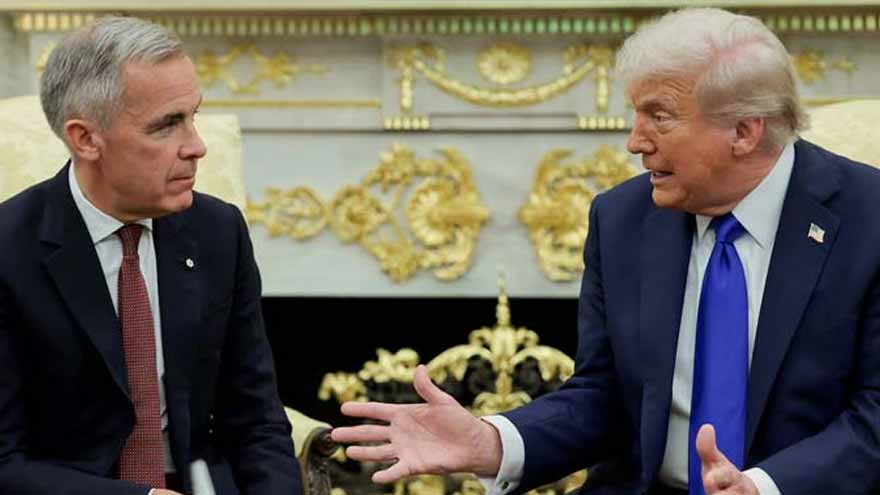
US President Donald Trump announced late on Tuesday night that he was putting a three-day pause on new 50% tariffs set to go into effect on Canadian goods on Wednesday, saying the two countries had reached an agreement.
The pause was “based on the fact that Canada and the USA, subject to the finalisation of documents, have a DEAL,” Trump said in a post on Truth Social.
An hour later, Canadian Prime Minister Mark Carney said in a statement that “substantial progress has been made, although there is important work still to be done.”
Trump added in his social media post that the Keystone XL Pipeline – a project cancelled by former President Joe Biden in 2021 after years of indigenous and environmental opposition – “may be awoken from the grave,” but did not provide details.
Trump’s post came after he spoke with Canadian Prime Minister Mark Carney on Tuesday afternoon, their second conversation this week, and after weeks of intense, opaque negotiations.
Existing US auto tariffs had been a sticking point, two industry sources familiar with the talks said earlier.
The new US tariffs would have covered about $20 billion worth of imports and applied regardless of whether Canadian goods qualify for preferential treatment under the US-Mexico-Canada trade agreement, which has shielded much of Canadian industry from earlier US tariffs.
‘Billions of dollars at stake’
Trade experts and industry officials say new tariffs could lead to job losses and business closures in vulnerable sectors, including lumber, wine and dairy. They also warn the dispute could complicate broader USMCA negotiations.
“There are billions in goods per year that were not impacted before, but now are at risk of being impacted significantly,” said Candace Laing, CEO of the Canadian Chamber of Commerce.
“Businesses have been doing a high-wire act for well over a year, holding off on hiring, investment and growing in Canada,” she said.
Canada’s minister responsible for US trade, Dominic LeBlanc, and chief trade negotiator Janice Charette have been in Washington since last week for talks.
On Monday, the Canadian officials met for nearly two hours with US Trade Representative Jamieson Greer and Commerce Secretary Howard Lutnick.
Greer has repeatedly cited Canada’s tariffs that followed initial US tariffs, some provinces’ refusal to stock US liquor and Canada’s dairy supply management system among US grievances.
Two sources said one of the main sticking points was US tariffs on Canadian vehicles.
The sides have discussed cutting US Section 232 tariffs on Canadian vehicles to 15% from 25%, with further reductions based on the amount of US content in each vehicle, the sources said.
The details of the deal touted by Trump remained unclear.
Counting tariff deductions
A major point of contention was how tariff deductions based on content should be calculated, with Washington demanding that only US-produced content be counted. Canada pushed for all North American content, including Canadian and Mexican parts, to be counted, the sources said.
Earlier on Tuesday, the US Commerce Department released new rules for automakers exporting from Canada and Mexico to certify their current levels of US content for tariff deductions, reducing the complicated exercise to once per year from twice.
But the Federal Register notice said automakers must re-certify vehicles’ American content by September 30 for them to claim deductions in the new annual cycle starting December 1.
A Canadian government source said last week that all options remained on the table if the new tariffs take effect, including government support for affected domestic industries and a possible suspension of bilateral trade talks, but the source expressed hope that the US was keen to reach a deal.
Business
Over Rs 200 million in financial irregularities at Lahore Training College are alleged in an inquiry report.
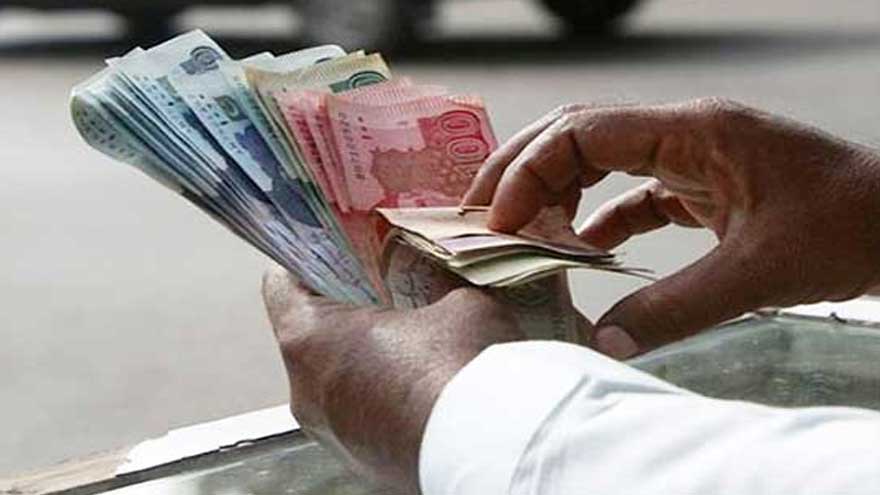
An inquiry report into alleged financial irregularities and embezzlement of more than Rs200 million at the Chowhang Training College Lahore has surfaced, recommending criminal and departmental action against several officials and individuals.
According to the report, Rs169 million was allegedly misappropriated under training fees, para and customs-related heads, while another Rs31 million was allegedly embezzled from food and canteen revenue.
The report further identified alleged irregularities involving Rs3.1 million in stationery and computer stationery, Rs9 million in furniture and machinery, Rs250,000 in tea and coffee, Rs2.7 million in transportation and Rs1 million under building-related expenses.
The inquiry committee recommended registration of criminal cases against contractor Yasir Ayub and accountant Shahbaz Khalid.
It also recommended departmental action against DIG Mahboob Aslam Lillah, DSP Shahid Javed and accountant Khalid over alleged serious administrative misconduct.
The report recommended departmental proceedings against Inspector Muhammad Asghar, Makhdoom Hussain, Ashfaq Ahmed, Shaukat Ali, Sub-Inspector Isra Hamad and Khalid Usman over alleged signatures on bogus bills and fabricated entries.
According to the inquiry report, subordinate officers and other personnel, including administrative staff, store in-charge, bookings and stationery clerks, remained posted at the relevant positions during the period under investigation.
The report alleged that contractor Yasir Ayub was operating the training college as a personal business while allegedly acting as a frontman for DIG Mahboob Aslam Lillah. It further alleged that fabricated records were prepared to facilitate the processing and release of payments.
The inquiry report said Yasir Ayub prepared bills under the names of six different companies, which it alleged were personally established by him.
The report further alleged that DSP Shahid Javed failed to resist allegedly unlawful orders of the commandant and instead ensured their implementation without obstruction.
According to officials, DIG Mahboob Aslam Lillah has been posted as Officer on Special Duty (OSD), while DSP Shahid Javed has been suspended in light of the inquiry report’s recommendations.

President Zardari promises to thwart attempts by foreigners to impede Balochistan’s advancement.

Following the missile attack, the UAE suspends all banking and trade relations with Iran.

Trump claims that a striking agreement between the US and Canada has temporarily halted tariffs.

ICC board meeting in India: Mohsin Naqvi gets invitation

23 people have died during the monsoon as rain-related incidents plague Punjab and KP.

Pakistan making rapid progress in robotics, AI: Shaza Fatima
-
 Latest News3 months ago
ICC board meeting in India: Mohsin Naqvi gets invitation
-
 Latest News1 month ago
23 people have died during the monsoon as rain-related incidents plague Punjab and KP.
-
 Latest News4 weeks ago
Pakistan making rapid progress in robotics, AI: Shaza Fatima
-

 Latest News3 months ago
A meta program to monitor mouse clicks made by employees in violation of EU privacy regulations
-
 Latest News4 weeks ago
After a divorce, LHC decides that women who have been harmed by their spouses get their dower.
-
 Business1 month ago
Govt dedicated to resolving Balochistan issues: Dar
-

 Business3 months ago
The IMF mission has arrived in Pakistan for discussions regarding the budget.
-

 Entertainment3 months ago
Interim bail given to YouTuber Rajab Butt in gambling app marketing case